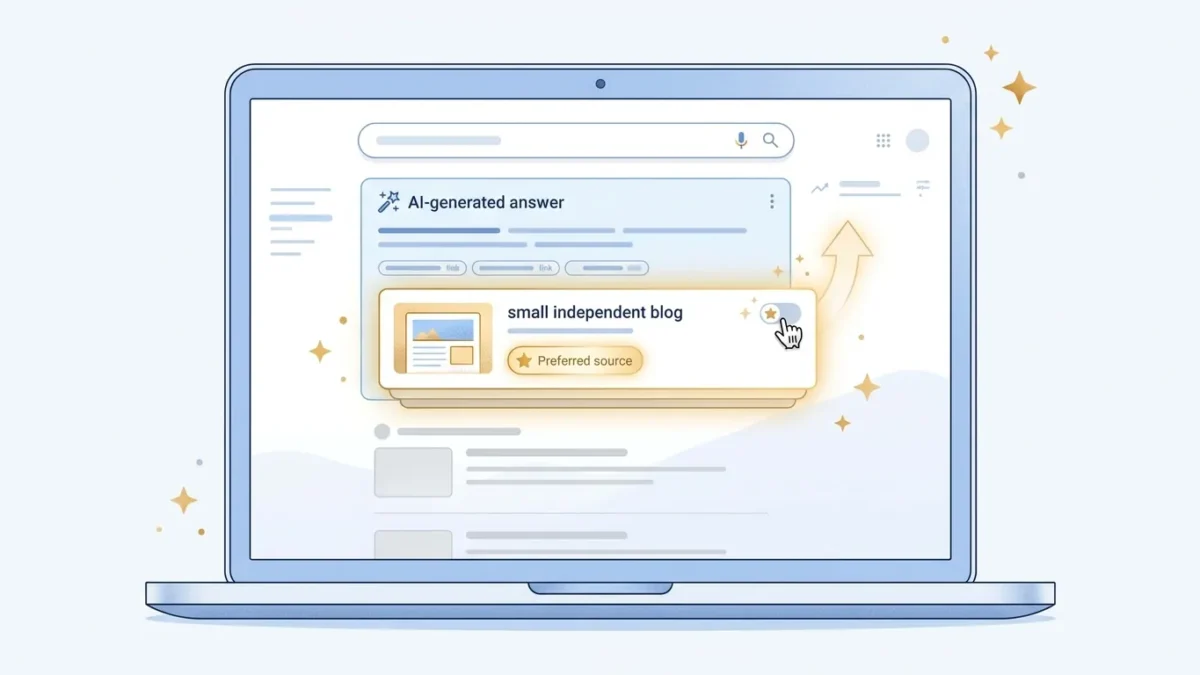
On October 15, 2026, Google announced “More ways to connect with the web from Search,” a set of changes to AI Mode and AI Overviews built around links: more of them, placed higher, plus news carousels that highlight readers’ Preferred Sources. Tucked into the same post was a striking number. Google said the number of people using its Preferred Sources feature “has grown by more than 7x since the start of the year.”
Google didn’t share a starting number, so 7x could mean a lot of people or not many. But for small WordPress blogs, Preferred Sources is one of the few AI search levers you can actually pull yourself. This guide covers what the feature does, what changed, how to ask readers to pick your site, and what it won’t do.
Key takeaways
- Preferred Sources lets signed-in Google users pick sites they want to see more of. Those sites get a label in Top Stories, AI Overviews and AI Mode, but only for the users who picked them.
- Google says use of the feature grew more than 7x in 2026. Readers had selected more than 600,000 unique sources by August.
- Any domain or subdomain that publishes fresh content can be eligible. Subdirectories such as
example.com/blogare not. - Google’s official button and deep link are the simplest ways to ask readers to add you.
- Google hasn’t published click data for these changes, and Search Console’s AI report shows impressions only.
What Google Preferred Sources Is
Google Preferred Sources is a personalization setting. A signed-in user searches for a site in Google’s source preferences tool, ticks it, and from then on Google shows that site more often for that person, with a “preferred” label, in Top Stories, AI Overviews and AI Mode.
The important part is who it affects. According to Google’s Preferred Sources guide for web publishers, the label appears for users who have selected your site. It isn’t a sitewide ranking boost. For everyone who hasn’t picked you, nothing changes.
How Preferred Sources Got Here
| Date | What happened |
|---|---|
| August 12, 2025 | Launched for Top Stories in the US and India |
| December 2025 | Expanded to English-language users worldwide; about 90,000 unique sources selected |
| May 27, 2026 | Added to AI Overviews and AI Mode with a visible label; more than 345,000 sources selected |
| August 20, 2026 | Official embeddable button that keeps readers on your site; more than 600,000 sources selected |
| October 15, 2026 | News carousels highlighting Preferred Sources expand to more locations and languages; Google says usage is up 7x since January |
One caution about the numbers. The 90,000, 345,000 and 600,000 figures count unique sites selected, not people. A site picked by one reader counts the same as a site picked by a million. The 7x figure counts people. They measure different things, so don’t treat one as proof of the other.
What Changed on October 15
Google’s announcement, written by Hema Budaraju, VP of Product Management, listed five changes. Some are rolling out and some are only tests:
- Inline links placed higher: Google says it’s updating AI responses to show inline links higher up, more often. It gave no figures.
- More news carousels: Carousels of timely articles that highlight Preferred Sources are rolling out to more locations and languages. Google didn’t list which ones.
- Bigger links at the end of responses: Some get image thumbnails and a more clickable design.
- Official pages at the top (planned test): A section showing one or two official sites for task-based queries.
- Clickable creator names (test): On AI Mode video results, creator and publisher names link to their Google Search profiles.
The announcement included no click-through or traffic numbers, so it’s too early to say how much these changes will send to websites.
Why It Matters for Small WordPress Blogs
Search referrals are shrinking, especially for publishers. According to Chartbeat data reported by Technology.org, Google Search referrals across Chartbeat’s publisher network fell 40.2% between July 2025 and July 2026. In a Pew Research study based on March 2025 browsing data, users clicked a regular search result on 8% of visits that showed an AI summary, against 15% without one. Google disputed Pew’s methodology. And publishers surveyed for the Reuters Institute’s 2026 trends report expect search traffic to fall a further 43% over three years.
Preferred Sources works differently from ranking. It doesn’t depend on backlinks or domain authority. It depends on whether readers like you enough to say so. Google says people click a preferred source about twice as often, though it hasn’t shared the baseline behind that figure. That makes it a good fit for niche sites with loyal readers, a theme we covered in why smaller niche brands can outperform bigger companies in AI search.
There’s a flip side: it favors sites that already have an audience. A brand-new blog with no readers has no one to ask yet.
How to Get Your WordPress Blog Picked: 5 Steps
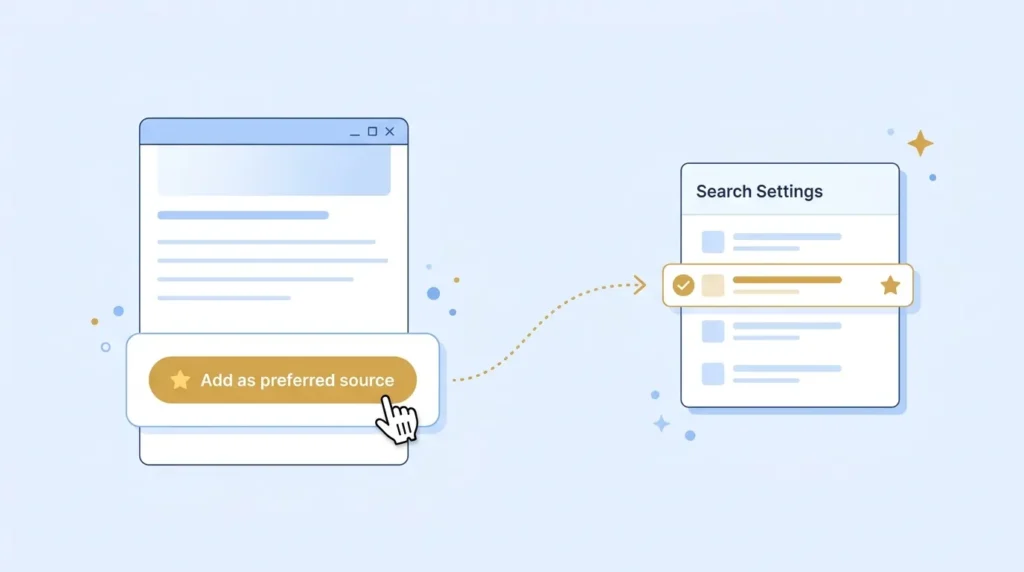
1. Check that your site is eligible
Go to google.com/preferences/source and search for your domain. If it shows up, readers can select it. Only domains and subdomains qualify (example.com or blog.example.com), not subdirectories (example.com/blog). To appear in AI Overviews and AI Mode, your site also needs to be eligible for Search’s generative AI features, so don’t opt out of them in Search Console.
2. Add Google’s Preferred Source button
Google provides an official button. Since August 20, it adds your site without sending the reader away from your page. Paste this into a Custom HTML block in your post template, author box or footer:
<script async src="https://news.google.com/swg/js/v1/publisher.js"></script>
<div google-add-preferred-source-btn></div>
Check Google’s documentation for the current snippet and the optional theme and language settings before you deploy.
3. Use the deep link where scripts can’t run
Newsletters, social posts and email signatures can’t run JavaScript, so use Google’s deep link instead. Replace example.com with your domain:
https://www.google.com/preferences/source?q=example.comThe deep link opens the source preferences tool with your site searched, but the reader still has to tick the box, so tell them that in your call to action.
4. Ask at the right moment, and say why
A button nobody notices does nothing. Ask after you’ve delivered something useful: at the end of a strong post or in a welcome email to new subscribers. Explain the benefit in one sentence, for example: “Add us as a preferred source on Google and you’ll see our posts more often in your search results and AI answers.”
5. Keep publishing timely, original content
Google names fresh content as the eligibility bar, and the expanded carousels feature timely articles. A blog that publishes once a quarter gives readers little reason to pick it and gives the carousels little to show. Google also says there’s no special markup or file needed to appear in its AI features, as we covered in Google’s position that GEO and AEO are still SEO. The fundamentals still do the work.
How to Measure It
There’s no dedicated Preferred Sources report yet, so measurement is partial:
- Search Console emails: In October 2026, Google started emailing some site owners a “Preferred source selections” count for their site. It’s the only direct figure available so far, and it isn’t in the Search Console interface.
- Generative AI performance report: Search Console’s AI report, available worldwide since August 31, 2026, shows impressions from AI Overviews and AI Mode by page, country and date. It shows no clicks. Those are mixed into the regular Web search type.
- Your own analytics: Track clicks on your button and deep link as a GA4 event, and watch returning visitors arriving from Google organic. A rise after a campaign is a useful signal, not proof.
What Preferred Sources Won’t Do
- It won’t help with searchers who haven’t selected you, which is most of them.
- It won’t fix zero-click searches. A labelled link still has to earn the click.
- It won’t replace the basics. Sites still recovering from the March 2026 core update need to fix content quality first.
Treat it as one building block: a cheap, low-risk way to turn loyal readers into extra visibility in AI search, alongside writing passages AI engines want to cite (see how Google now cites paragraphs instead of pages).
Frequently Asked Questions
What is Google Preferred Sources?
It’s a Google Search setting that lets signed-in users choose websites they want to see more often. Chosen sites appear more frequently, with a “preferred” label, in Top Stories, AI Overviews and AI Mode for that user.
Does Preferred Sources work in AI Mode and AI Overviews?
Yes. Since May 27, 2026, links from a user’s preferred sources are labelled in AI Overviews and AI Mode. Since October 15, 2026, news carousels in those features highlight preferred sources in more locations and languages.
Can a small blog become a preferred source?
Yes. Any domain or subdomain that publishes fresh content can be eligible, not just news sites. Search for your domain at google.com/preferences/source to check.
Is my blog eligible if it lives at example.com/blog?
No. Only domain-level and subdomain-level sites qualify. A blog at blog.example.com can be selected; one at example.com/blog can’t be selected on its own, though the parent domain can.
How do I add the Preferred Source button to WordPress?
Add Google’s script and button snippet to a Custom HTML block, a reusable pattern, or your theme’s footer or author box. Use the deep link in newsletters and social posts.
Is Preferred Sources a ranking factor?
Not in the usual sense. It changes what users who selected your site see. It doesn’t raise your rankings for everyone else.
How many people use Preferred Sources?
Google hasn’t published a user count. It says the number of people using the feature grew more than 7x since the start of 2026, and that readers had selected more than 600,000 unique sources as of August 2026.
How can I see how many readers picked my site?
There’s no Search Console report yet. Some site owners began receiving a “Preferred source selections” count by email in October 2026. Otherwise, track clicks on your button and deep link in your analytics.
Sources
- Google: More ways to connect with the web from Search (October 15, 2026)
- Google: New ways to find your favorite sources and original content in AI Search (May 27, 2026)
- Google Search Central: Guide to Preferred Sources for web publishers
- PPC Land: Google pushes links higher in AI answers as Preferred Sources use rises 7x
- PPC Land: Google Preferred Sources gains 255,000 selections since late May
- Search Engine Journal: Google Preferred Sources hit 345K, expand into AI search
- Search Engine Journal: How to add Google’s Preferred Sources button to your website
- SEO Kreativ: Google Preferred Sources timeline and guide
- Technology.org: Google Search traffic to publishers fell 40%
- Search Engine Journal: Pew Research on AI Overviews and clicks
- Reuters Institute: Journalism, media, and technology trends and predictions 2026
- Search Engine Journal: Search Console AI reports rolled out worldwide
- Relevant Audience: Search Console Preferred Source email