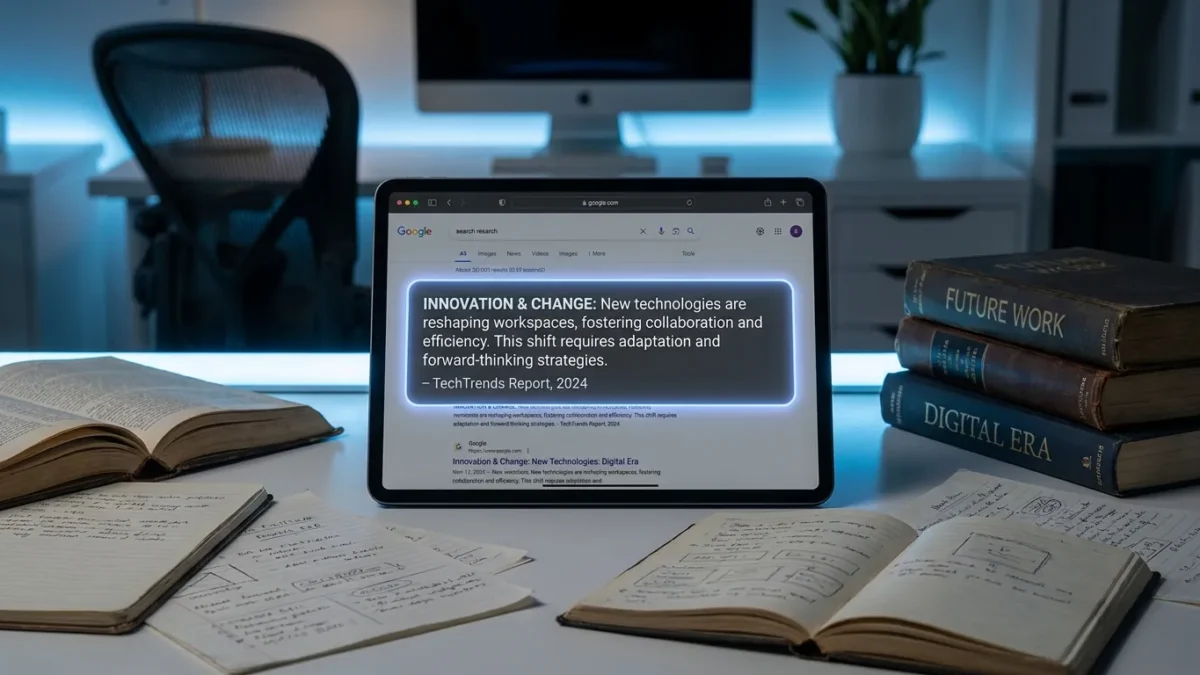
AI Mode’s working unit of citation is the passage, not the URL. A year-long Pillarbase study published on Search Engine Land reveals that of 15,699,298 AI Mode citations across 148 industries, 47.7% were scroll-to-text highlights rather than plain links. This research resolves to 4.6 million unique highlighted passages across 2.7 million pages. Most passages (80.9%) were cited once, while around 2,300 passages were reused 61 or more times. The most-recycled passage was cited 661 times across 483 distinct queries. Pages with 21 or more highlighted passages achieved a median #1 organic rank. Supporting detail: Bright Data’s analysis of 42,971 citations found that 92.4% of AI Mode and Gemini citations are self-contained full sentences of 6–20 words.
What Passage-Level Citation Means and How Scroll-to-Text Highlighting Works
A passage-level citation is a link that carries a text fragment identifier, sending the reader to a specific highlighted sentence or paragraph rather than the top of a page. Google citation changes have made this the default behavior in AI Mode for close to half of all cited sources.
The mechanism is scroll-to-text highlighting. When AI Mode cites a source, the URL frequently contains a #:~:text= fragment that instructs the browser to scroll directly to the matched sentence and highlight it in yellow. The reader never sees the introduction, the byline, or the three paragraphs of context that preceded the answer. They see the sentence that resolved their question.
Scale matters here. According to the Pillarbase AI Mode citation study, the 15.7 million citations resolved to 4.6 million unique highlighted passages across 2.7 million pages. That is roughly 1.7 highlighted passages per page on average, which means most pages are contributing one or two extractable units and nothing more. Publishers tracking only URL-level impressions are measuring the wrong object. The related shift in traffic patterns is covered in more detail in this analysis of AI Mode reaching one billion users.
A recipe blogger ranks a 2,400-word post on sourdough hydration. AI Mode cites it eleven times across two months. Every citation points at the same 90-word paragraph explaining baker’s percentages. The other 2,310 words have never been highlighted once.
The Compounding Effect — Trusted Passages Get Reused Across Many Different Queries
Passage reuse is heavily concentrated. The Pillarbase data shows 80.9% of passages were cited once, while approximately 2,300 passages were reused 61 or more times, and the single most-recycled passage was cited 661 times across 483 distinct queries.
That distribution describes a compounding asset rather than a lottery ticket. A passage that survives repeated retrieval becomes a default answer unit for a cluster of related prompts. The 483 distinct queries behind that top passage were not variations of a single keyword; they were separate user intents that all resolved to the same block of text. Organizations building topical depth are effectively manufacturing candidates for this kind of reuse.
The correlation with organic performance is worth stating carefully. Pages with 21 or more highlighted passages had a median rank of #1, with 67% ranking first outright. Direction of causation is unresolved. Highly ranked pages attract more retrieval attention, and heavily extractable pages may earn better rankings. The data establishes association, not a guarantee.
Similarweb reported that the number of AI responses including a citation has risen more than fivefold during the past year, and that AI Mode visits climbed from 126 million in June 2025 to 279 million by May 2026. Citation surface area is expanding while the unit being cited is shrinking.
Anatomy of a Citable Passage
A citable passage is a self-contained block that answers one question without requiring the sentences before or after it. Bright Data’s analysis of 42,971 citations found 92.4% of AI Mode and Gemini citations were self-contained full sentences of 6 to 20 words, never mid-sentence fragments.
Length behaves differently at the paragraph level. Pillarbase found the median highlighted passage was 117 words: a complete, multi-sentence answer. The sentence-level finding and the paragraph-level finding are compatible. Retrieval systems favor clean sentence boundaries, then extract the surrounding block that carries the full answer
Three rewrite patterns illustrate the difference between hedged prose and extractable prose.
Before: “As we discussed in the previous section, there are a number of factors involved here, and while results will obviously vary, most people find that this approach tends to work reasonably well in practice.” After: “Cold-water proofing slows fermentation by roughly half, extending bulk rise from four hours to eight at 12 degrees Celsius.”
Before: “It depends on your setup, but generally speaking this is something worth considering for most sites.” After: “WordPress sites running Core Web Vitals scores above 90 load in under 1.2 seconds on 4G connections.”
Before: “Building on the point above, the same logic applies here as well.” After: “Schema markup does not improve rankings directly; it improves the accuracy of how search systems interpret entity relationships on a page.” Publishers implementing structured data will find the type-by-type breakdown in this guide to JSON-LD schema types for AEO useful for that work.
The failure mode in each “before” example is dependency. Anaphoric openers such as “this”, “that approach”, or “as mentioned” break self-containment. A retrieval system cannot resolve the referent, and the passage becomes uncitable regardless of how accurate it is.
A 10-Point Passage Audit Checklist for Existing WordPress Posts
Auditing at passage level differs from auditing at page level. The following ten checkpoints apply to individual paragraphs within already-published posts, prioritizing pages that already rank in the top ten.
- Every H2 is followed within one paragraph by a direct, complete answer to the heading.
- No paragraph opens with “this”, “that”, “as noted above”, or a similar unresolved reference.
- Answer paragraphs sit between 40 and 120 words, matching the observed 117-word median.
- Sentences carrying the core claim run 6 to 20 words, in line with the Bright Data finding.
- Each numeric claim appears in the same sentence as its unit, timeframe, and condition.
- Hedging language is removed from claim sentences and relocated to a following qualifier sentence.
- Entity names are written in full at least once per section rather than replaced by pronouns.
- Definitions are stated as “X is Y” rather than described across three sentences.
- Tables and lists carry a preceding sentence that states what the structure demonstrates.
- Long posts contain multiple distinct answer blocks rather than one, given the correlation between passage count and rank.
Referrer strings containing #:~:text= are the practical evidence trail. Publishers running that check against server logs can identify which paragraphs are being highlighted. Comparative citation behavior across platforms is examined in this breakdown of which AI platforms cite WordPress sites most.
The Counterpoint: Content Should Not Be Chunked Purely for Machines
Google has pushed back on the idea of restructuring content solely to satisfy language models. Danny Sullivan has argued against chunking as a shortcut strategy, and that objection deserves weight rather than dismissal.
The argument holds because retrieval systems change faster than content libraries do. A site rebuilt around one extraction pattern inherits structural debt when that pattern shifts. Passages engineered for machines also tend to read as disconnected assertions, which damages the reading experience that generated the authority in the first place.
The defensible position is that passage-level clarity serves readers first. A paragraph that answers one question completely, without requiring the reader to reconstruct context from three screens above, is better writing by any standard applied before AI Mode existed. Google’s guidance on the relationship between these acronyms and established practice is summarized in this piece on why GEO and AEO are still SEO.
An accompanying video walks through the underlying mechanics of how language models process and retrieve text, covering tokens, transformer attention, and retrieval-augmented generation. The presenter frames the citation question directly: “A citation means that the LLM actually links to your brand, whether that’s an article, your homepage, YouTube, whatever.” The video also separates brand mentions from citations, noting that Ahrefs found ChatGPT cites about half of the URLs it retrieves, and that Profound data reported by SEO outlets showed ChatGPT referral traffic dropping by 52% after citation patterns shifted.
What Publishers Should Watch Next
Citation volatility is the open risk. Google citation changes have already redistributed attribution once this year, with google.com becoming the #2 most-cited domain in AI Mode according to Profound’s tracking of more than 32 million search viewer instances between April and June 2026. Self-preferencing at that scale compresses the space available to independent publishers.
Marketers are reallocating budgets toward passage-level measurement as costs of paid acquisition rise and click-through rates soften for pages that lose attribution. Similarweb also observed that average search query length has risen, indicating users are replacing short keyword queries with longer conversational prompts, which broadens the range of questions any single well-formed passage might answer.
No study establishes that restructuring content guarantees citation or ranking improvement. Pillarbase measured correlation across 2.7 million pages, and correlation at that scale is informative without being predictive for any individual site. Sites recovering from algorithmic volatility should review the diagnostic steps in this guide to recovering from a core update traffic drop before assuming citation formatting is the constraint.
The measurable consequence of Google citation changes is that the paragraph has become the competitive unit. Publishers auditing at page level are grading a document that no longer matches how the system reads.
Video Transcript
If you're stuck in, "I don't know how LLMs or AI search find and recommend websites," and you're trying to get to, "I know how to check if my website appears in AI search, and I know what to do if it doesn't," you might feel like you need a huge stack of tools, guides, and resources. Well, you don't. I've worked in the answer engine optimization space for a long time.
And the biggest thing I see people struggle with is too much information. There's so much noise around AI and SEO right now that it's hard to know what actually matters. So in this video, I'm going to walk you through the five things you actually need to understand about AEO if you want to start tracking and improving your visibility in AI search. I've covered pieces of this before.
Ranking in ChatGPT, optimizing your website for AI search, getting customers from ChatGPT. But this is the first time I'm putting the full foundation in one place. Think of it as the only AEO crash course you'll ever need. So what are LLMs, and how do they work?
What Are LLMs and How Do They Work? Let's start from the basics. LLM stands for Large Language Model. That sounds technical at first, but the idea is pretty straightforward.
It's a type of AI trained on huge amounts of text so that it can understand patterns in language and generate useful answers. Think of it as an advanced autocomplete running on probability. Now, there are quite a few things under the hood of a large language model like ChatGPT or Claude. First is a token, which is how an LLM processes anything you feed into it.
A token can be a full word, a partial word, a punctuation mark, or even a space. Since LLMs can't actually read words the way that we do, it breaks any text down into tokens, then turns those tokens into numbers, because numbers are what computers can work with. So words like traffic, rankings, and impressions may be close to each other because they often come up in similar contexts.
Still with me? Good. Then comes the architecture behind most modern LLMs, the transformer. The transformer is what helps the model look at all of the words inside of the prompt and figure out how they relate to each other.
Before transformers, AI models had a much harder time understanding long pieces of text because they processed words sequentially. So if you had a sentence like, "The dog chased the ball across the yard because it was bouncing." An older model would have moved across the sentence one word at a time: "The dog," "chased," "the ball," and so on. That means that by the time it got to the word "it," the model had to rely on information it had carried forward from earlier in the sentence to understand what it referred to.
In a short sentence, that might be fine. But in a longer paragraph, important context might be buried or weakened along the way. Transformers change that because they can look at many parts of a sentence or paragraph and figure out which parts matter the most. And they're able to do this through something called attention, which also helps the LLM understand context.
For example, take this sentence: "The dog chased the ball because it was bouncing." When the model gets to the word "it," it needs to figure out what it refers to. Is it the dog or is it the ball? Attention helps the model look back at the sentence and weigh connections between words. In this case, "bouncing" is much more strongly connected to the word "ball" than it is to "dog." So the model can use that context to understand the sentence more accurately.
Those are a lot of words, so let's get more practical. What happens when you ask an LLM a question? Well, remember when I said LLMs are trained on a massive amount of text? That training is what gives the model its general knowledge on facts, concepts, and how ideas relate to each other.
But when you ask a question, the model isn't opening up its training data and searching through it like it's a database. It's more like the training has shaped the model's internal understanding. So when you ask something like, "Why is the sky blue?" How Do AI Tools Find and Generate Answers? The model uses the patterns it learned during training to predict a clear, likely answer.
It looks at your prompt, breaks it into tokens, uses context to understand what you're actually asking, and then starts generating a response one piece at a time. But here is where it gets interesting. LLMs like ChatGPT don't just rely on what they learned during training. They can also use something called retrieval-augmented generation, or RAG.
Basically, RAG means that the system can fetch outside information before providing an answer. So instead of relying on the model's built-in knowledge, the tool might search external sources: websites, documents, help centers, product pages, and then give that information to the model as extra context. Then that model uses that retrieved information to generate a better answer. So the process might look like this.
First, you ask a question. Then the system decides whether the model has enough context or needs extra information to provide an answer. If it needs extra information, it searches external sources and pulls in the most relevant pieces of information. Then the LLM reads your question plus that retrieved information and generates an answer.
That's why two AI tools can answer differently. One might be relying mostly on the model's training, How LLMs Are Changing Search and SEO another might be pulling from external sources before generating an answer. Okay, so how do LLMs impact search and SEO? So now we basically have a technology that's pretty much the world's biggest probability machine.
Why is that something we should care about as an SEO marketer or just someone trying to sell stuff online? Because there's nothing humans love more than having somebody else do their homework for them. For years, search has made us work for the answer. You type something into Google, open 12 tabs, skim five listicles, ignore three ads, check Reddit to see what real people are saying about it, maybe watch half a YouTube video, and then eventually piece together your own conclusion like you're solving some internet crime scene.
LLMs cut straight through that. You just go to ChatGPT and ask, "What's the best rank tracking tool for an SEO agency?" And instead of having to personally go through each "top 10 rank trackers for 2026" article on the internet, you get a neat little answer. Here are the options, here's what each are good for, here's what I'd watch out for, and here's the one I'd personally recommend.
That is a far more convenient search experience. I mean, it was just a matter of time before people embraced this new personalized way of searching for things. In fact, ChatGPT reportedly handles around 2.5 billion prompts a day. That's about 75 billion prompts a month.
Now, not all of those are searches in the traditional Google sense. But a huge chunk of people are clearly using it to ask questions, compare products, and make decisions online. Why AI Search Visibility Matters Now So yes, users have embraced LLMs. The genie is out of the bottle, she has Wi-Fi, and she's not going back in.
But what does that mean for you? First, you have a new channel where people can discover you. That's good news. More chances to get in front of someone who is actively asking questions about the things that you sell, offer, or teach.
If people are asking LLMs about product recommendations, how-tos, alternatives, and so on, then it is your job to understand how to make your brand part of the answer. Because whether we like it or not, visibility is no longer exclusive to Google. It's also a ChatGPT answer, a Perplexity citation, a Gemini summary, a Claude recommendation, or an AI Overview. The party has moved to multiple rooms, and unfortunately we have to mingle.
Second, and this is the less sparkly part, the traditional Google search experience is changing too. Are AI Overviews Reducing Website Clicks? Google has gone all in on AI as well, first with Gemini and then AI Overviews, and now AI Mode. In fact, they're totally redesigning the Google search box to accept longer and more interactive search queries in different formats.
Visibility is no longer as simple as ranking first, collecting your clicks, and riding off into the sunset. Cute idea, very 2018. Now, someone might see an AI-generated summary, get their answer, and never click. AI Overviews reduce clicks by about 45%.
So even if you rank first, that does not mean you get the same amount of clicks as you used to. And the third point is that we're now playing a different game. You can call AI search an extension of SEO. You can call it generative engine optimization, or GEO.
You can call it answer engine optimization, or AEO. You can even call it "please not another acronym," and I'd support that. But the label is not really the point. The point is that search behavior is changing.
People will not just type in keywords into a search box. They are having conversations. They are comparing options in one prompt. They are asking for recommendations with context like, "I'm a small business.
I need something affordable. I need something easy." That changes what it means to be visible in organic search. SEO has not just been about ranking in Google for a long time, if we're being honest. Search already expanded into YouTube, TikTok, Reddit, marketplaces, social media platforms.
LLMs are another major layer in that same shift. So yeah, it's a mixed bag. On one hand, there are new opportunities to be discovered by your ideal customer. On the other hand, the old playbook of rank, get clicks, profit is getting a little wobbly in the knees.
Now let's move on to AEO terminologies you should know. At this point, you're probably thinking, "Okay, I get it. LLMs are changing search. People are asking questions, comparing products.
What do I need to do to show up?" Key AEO Terms You Need to Know We're going to get to that, but before we talk tactics, it's useful to know four important terms that you hear a lot in this space. First is prompts. A prompt is the input given to a large language model that conditions or guides its output. In plain English, it's the text or instructions that you give to the model so it knows what to respond and how to respond.
When you ask ChatGPT a question or to do something, you're giving it a prompt, which it then breaks down into tokens and numbers, vis-à-vis everything I shared earlier. But isn't a prompt just a keyword? No, it is not, and it's actually one of the biggest differences between searching in an LLM and searching in Google or Bing. A keyword is typically short and to the point.
Sure, we do have long-tail keywords, but they're usually fairly concise. LLMs let you input more contextual queries. So instead of searching for something like "best keyword tracking tools for small SEO agencies," you can pour out your entire heart and say something like: "I run SEO for a small B2B SaaS. I need a keyword rank tracking tool that will allow me to geolocate rankings.
I have a team of three. I don't have much budget. I need something that's easy to set up. Can you recommend three tools for me?" That whole thing is a prompt.
It has the topic, yes. But it also has the context. It tells the AI who you are, what are your constraints, what you're trying to achieve, and what the answer should look like. It's also one of those things that makes AI search so nifty.
People aren't asking LLMs the same way even when they're looking for the same thing. That's why showing up in AI search isn't as simple as picking a keyword with high search volume and low difficulty, creating content, ranking, and getting found. It's much messier. So what I'm saying here is that the goal is less about matching for one exact phrase and more about being connected to a topic from multiple angles.
Your brand needs to show up around the problem, use case, comparison, and questions people are actually asking. Brand Mentions vs Citations The second thing you need to understand is mentions and citations. In traditional SEO, we talk a lot about ranking. You rank number one, number two, number three, and so on.
But LLMs don't work exactly like a traditional search results page. There isn't always a clean list of 10 blue links where you can say, "I'm ranking number three." So when people say "ranking in ChatGPT," they don't usually mean it in the traditional Google sense. What they really mean is: does ChatGPT cite or mention you? Getting mentioned and getting cited are two different things.
A brand mention is when your brand, website, or content appears in the AI's response. Say you ask, "What are the best keyword rank trackers for growing SEO agencies with three to 50 people?" And the response says, "Some good options are keyword.com, Semrush, and SE Ranking." If keyword.com shows up in that answer, then that's a brand mention. The AI is naming our brand as part of the response.
A citation means that the LLM actually links to your brand, whether that's an article, your homepage, YouTube, whatever. So the person who asked the question can actually click the link and go to the source of the answer. That's what shows up as referral traffic. So should you aim to get mentioned or cited in AI search results?
Ideally, both. Citations are much easier to track, especially when you're selling AEO services to clients. You can easily say, "Look, our referral traffic from ChatGPT is up 20%." The client's happy, the contract's safe. But getting cited is not so easy.
LLMs aren't built to send traffic. Their main job is to answer the user's query and keep the experience as seamless as possible. Basically, give people enough information so that they don't have to open five tabs and go digging around the internet themselves. And we're already seeing that play out.
Ahrefs found that ChatGPT only cites about half of the URLs it retrieves. So even if your page is pulled in the answer process, it doesn't automatically mean you'll get a visible link. And citations can be volatile too. Profound data reported by SEO outlets showed ChatGPT referral traffic dropping by 52% after citation patterns shifted.
So yes, citations matter. They're clickable, trackable, and very nice for reporting. But LLMs are not built like traffic machines. They're built to answer the user's question.
Sometimes that answer includes links, sometimes not. For AI search, you'd want and need to track both. Moving on to the third point, now that you understand prompts, brand What Is AI Share of Voice? mentions, and citations, the next thing to understand is AI share of voice.
You might already know share of voice from SEO. It's basically a way of asking: how visible are we compared to everyone else? In regular SEO, this means looking at a group of keywords and seeing how often your site shows up compared to competitors. You can easily do this with Keyword.com.
In AI search, it's the same general idea, but instead of looking at rankings, you're looking at answers. So AI share of voice is how often your brand gets mentioned in AI answers compared to your competitors. That's it. If people ask 10 different prompts about your category, how often do you show up?
There are a couple of things tracking AI share of voice tells you. First, it tells you whether AI tools actually associate you with the topics you care about. You might think you're a major player in the category, but if ChatGPT, Gemini, or Perplexity never mention you when people ask about that category, that's a visibility problem. Second, it shows you who AI tools see as your competitors.
Honestly, this one's always surprising because as a brand, you probably have a clear idea as to who your competitors are. But LLMs don't always see the market the same way you do. Because they're pulling from patterns across the web, they might group you with brands that appear in the same articles, target the same use cases, or appear in the same comparison pages. So you might think that your main competitor is brand A, but the AI keeps putting you next to brand B and brand C.
That's super useful because it tells you how the market is being framed outside of your own head. Third, it helps you to see what kind of prompts you're showing up for. Maybe you appear when people ask broad category questions but disappear when they ask for "best tools for SEO agencies" or "affordable tools for small teams." That tells you where your visibility is strong and where it's weak.
And finally, it gives you a way to measure your progress over time. Not just, did we get more clicks? But are we getting mentioned more often? Are we appearing alongside the right competitors?
Are citations improving? So AI share of voice is basically your visibility scorecard for AI search. And fourth, this is one that people hardly pay attention to: AI sentiment. This basically means: when AI mentions you, what's the vibe?
What is AI Sentiment and why does it matter for your brand? Getting mentioned or cited by AI is not automatically good. The answer could say you're a great fit for a specific use case. That's great.
Or it could say you have terrible customer support and you're extremely pricey. Still a mention, technically, but not one that you'd print out and frame. This happens because LLMs are picking up signals from what exists about you online. Reviews, comparison pages, articles, forums, your own website.
All of it. So if the general story around your brand is clear and positive, great. If you have a ton of angry G2 reviews, not so great. Tracking AI sentiment tells you how the LLM is framing your brand for your audience, which affects brand perception.
With this, you can answer questions like: is my brand being described the way I'd like? If not, what's influencing that? Is the AI pulling from old reviews? Is someone playing dirty and publishing comparison content that is doing a little too much creative writing?
Once you know that, you can actually do something about it. You can update your own positioning. You can create better comparison pages. You can address common objections more clearly.
You can get more customer proof out there. You can even refresh outdated content or build third-party validation. You can correct the story and the sentiment the model is picking up. There's actually a fifth point I was going to forget, but it's a really important one, and that's visibility score.
AI Visibility Score Explained Visibility score is a way to measure how visible your brand is in AI search results, but with a bit more nuance than just: are we mentioned or not? AI search is not a fixed index like in a traditional Google search sense. In Google, if you rank number three today, you can usually go back and check that ranking again. It might move over time, but it is relatively stable.
AI answers are completely different. You can ask the same prompt multiple times and get different answers. One response might mention your brand, another might not. One answer might put you first in the list, another might bury you at the bottom, and another might just skip you completely.
Visibility score helps account for that volatility. At a simple level, visibility score looks at two things. First, the detection rate. How often does your brand appear across a set of AI responses?
And second, the average rank. When your brand does appear, how high up in the response or prominently is it shown? So if your brand appears in most responses and is usually mentioned at the top, your visibility score, at least for that prompt, will be strong. And if your brand only occasionally appears, and when it does appear, it's buried below your competitors, then your visibility score will be weaker.
Okay, so now that we've covered the terms, the next question is: How to Track AI Search Visibility how do we actually track this? AI search is not like traditional SEO where you can say, "We're ranking number three," and call it a day. With AI search, you're tracking a few different things at once: whether your brand shows up, where it shows up, how often it shows up, whether it gets cited, and what the AI is actually saying about your brand.
Let's start with the easiest one, tracking whether your brand is showing up at all in AI answers. Doesn't matter if it's citations or mentions. First, you need a list of prompts that your audience is likely typing into ChatGPT or Perplexity to find what you're selling. Not just clean, keyword-style prompts like "best keyword rank tracker." You want the messy, specific human versions too.
Things like: "What's the best rank tracker for a small SEO agency?" Or, "What keyword rank tracking tool should I use if I want to track multiple locations, and I want something that isn't hard to use?" You can actually find AI prompts derived from long-tail queries in Google Search Console. You can also mine them from customer conversations, from sales calls to forums like Reddit. If you have less than 10 prompts, you can actually find suggested prompts within keyword.com to track for AEO.
But keep things simple. A list of 10 to 20 prompts is already a great start. In my keyword.com dashboard, I'll add my website URL, then the prompt list we created earlier. From there, you can choose the AI engines you want to track.
Keyword.com pretty much tracks everything from ChatGPT to AI Mode and Perplexity, so you really see the full picture of your brand's visibility in AI search results. Next, choose your AI brand monitoring frequency, how often you want keyword.com to run the same checks, and wait for the data to roll in. Once the data starts coming in, you're looking at a few things. First, mentions.
Is your brand showing up in the answer at all? Second, citations. Is the AI actually linking to your website, content, or the owned sources? And sentiment.
When the AI talks about you, is it describing you in a way that actually helps the right people choose your brand? From the keyword.com AI visibility results, you'll also notice a few things, like the competitor who keeps showing up in AI answers, or that one AI search engine that is weirdly obsessed with Reddit. That's good data you'll need for the next part of this course, so keep it handy.
You can also do this process manually. It's going to be tedious and far less reliable, but it's still a good starting point if you're trying to figure out the baseline for your brand in AI search results. Open a logged-out version of ChatGPT. Logged out is important because you don't want your chat history, memory, or personalization quietly putting its thumb on the scale.
We want the cleanest possible version of the answer. Then run through your prompts one by one. Ask the question, look at the answer, and don't overthink it. So your little manual audit looks like this: ask the prompt, screenshot or save the answer, note whether you were mentioned, note whether you were cited, and write down the framing.
And because AI answers can shift, one round of prompts is not enough. Unfortunately, this is not a one-and-done situation. You'll want to repeat this exercise for about a month to spot trends and insights. Okay, so now you know how to track your visibility in AI search.
You know how to check your prompts, mentions, citations, share of voice, sentiment, visibility score, all of that. The next question is: how do you actually improve it? Because yes, tracking is cute. Love me a good dashboard.
But at some point, we need to move from "what is AI saying about us?" to "what can How to Influence AI Answers we do to influence what AI says about us?" The low-hanging fruit is to go back to your AI visibility results and look at what type of content is showing up for the prompts that you care about. Is it a Reddit thread, a LinkedIn post, a G2 review, a YouTube video?
Whatever it is, you need to find a way to get into those existing conversations. If a Reddit thread is being cited, can you leave a helpful comment there? Not a "Hi, please buy my product" type of comment. Nobody likes that person.
But an actual useful answer that adds context, explains a trade-off, or answers the question better. If a listicle is getting cited, can you reach out to the writer or publication and make a case for your brand to get mentioned? If G2 or another review site is showing up, maybe your move is to get more reviews, improve your profile, clean up your positioning. Or make sure that your best-fit category is obvious.
But don't stop at the individual source. The bigger question is, why does this type of content keep on showing up? If Reddit keeps on appearing, it tells you that community conversations are important for your category. If review sites keep on appearing, reviews are probably a major trust signal.
If YouTube videos keep on getting cited, then maybe YouTube needs to be part of your content strategy, just like I'm doing right now. Now let's move on to some longer-term tactics. The first one is to fix information consistency. It might sound boring, but it matters a lot.
AI tools are pulling from a whole bunch of different places. Your website, review sites, listicles, social media profiles, YouTube descriptions. Maybe even random pages you forgot about. And if all of those places describe your brand differently, you're making AI piece together your identity like a detective with bad evidence.
So before you start trying to hack AI search, start with the boring fundamentals. Make sure your website clearly explains: who your product is for, what problem it solves, what category it belongs in, what use cases it supports. Who is it best compared against? What makes it different?
What integrations, features, pricing, and proof points matter? And then make sure that same story shows up everywhere, from customer reviews to Reddit comments to social media profiles. This is where you need what I like to call a brand fact sheet. Not necessarily a public-facing page, although that can help, but a clear source of truth for how your company should be described across the internet.
Your entire team should work with this so that you're stating the same proof points across the entire board. Second, make sure that AI systems can actually retrieve information from your website. How to Make Your Website Easy for AI to Read AI can do a lot of things. It can write code, summarize research, and even plan your entire SEO strategy.
But it can't reliably read JavaScript, and that's a problem because a huge chunk of modern websites are built on JavaScript. See where I'm going? No? Okay, well, let me explain.
So let's say you go to ChatGPT and ask, "What are the most popular pet stores in Paris in 2026?" ChatGPT says, "Oh, look, this person is looking for recent information, so I'm going to do a web search." So it triggers a web search and finds the pages that might have an answer to your query. It starts opening the pages one by one and tries to read the content.
Then it comes across your website, it opens the content and finds nothing, because your content only loads after JavaScript runs. Remember, someone is waiting for ChatGPT to provide an answer, so it can't wait indefinitely for your content to load. So the logical thing to do is to just skip your website. And that's why you don't get recommended even when your content is exactly what ChatGPT is looking for.
So how do you fix this? It gets a bit technical, but basically, make sure that your content shows up in the HTML first. There are a few ways to do that. Use server-side rendering so that the page loads with the content already there.
Instead of sending the user to an empty page that JavaScript then fills in, the server does that work, and sends the user the page with the content already there. Next, use static pages for things like blog posts and landing pages. For content that doesn't change often, like landing pages or blog posts, just pre-build the HTML files to serve them directly. Or lastly, you can use pre-rendering.
This is a middle ground for JavaScript-heavy websites. A tool visits your website, waits for JavaScript to run, and then saves the content as HTML files that it serves directly to the crawlers. The advantage is that the user still gets the JS experience, but the bots see the ready-made HTML. If you don't want to get drawn into the technical side of things, just ask your SEO or the agency you're working with to make sure that your website is Why Off-Site Signals Matter for AEO accessible by ChatGPT and other AI bots.
Third is: build your brand footprint beyond your website. This is one of the biggest differences between traditional SEO and AI search. With traditional SEO, a lot of the work was centered on the website. Yes, backlinks mattered.
But for a lot of terms, if you created a good page, optimized it properly, and kept improving it, there was a fair chance you would be able to rank. AI search is not like that. They're pretty much an aggregation and validation machine. Which is a fancy way of saying that they're pulling information from a whole bunch of sources and then weighing their findings to figure out what to tell the searcher about your business.
So if your website says your restaurant has the best pasta, but then G2 and Reddit threads say this pasta is not good, AI is likely to pick up on that and share it with your prospective customers. This is also where having information about the type of content that's used comes in very handy. If you notice that AI is consistently citing Reddit threads but you have no presence there, then that's a sign for you to start working on your Reddit presence.
It's the same for LinkedIn, YouTube, whatever it may be. But, and this is very important, this doesn't mean you should just go and spam your brand name everywhere. Please don't do that. Don't go into Reddit threads and leave comments like, "Have you tried our product?" Nobody likes that person, especially not the mods, and it can hurt your brand.
The point is to actually show up in these channels properly. Final AEO Takeaways and Next Steps From my own experience, you can't treat Reddit, YouTube, or podcasts as your dumping ground for brand mentions. You need to show up and properly engage with your channel and audience, and ultimately, you need to try to be useful before you try to be promotional. And so that's the foundation for AEO.
A lot of what I've covered here are much bigger concepts on their own. Prompts, citations, share of voice, tracking, sentiment, all of that. That's why I have my AI search playlist where I'm diving into each one by one. So be sure to check that out.
I'd recommend starting with this video on how to find prompts for AEO, because that's the next best step once you've figured out the basics.