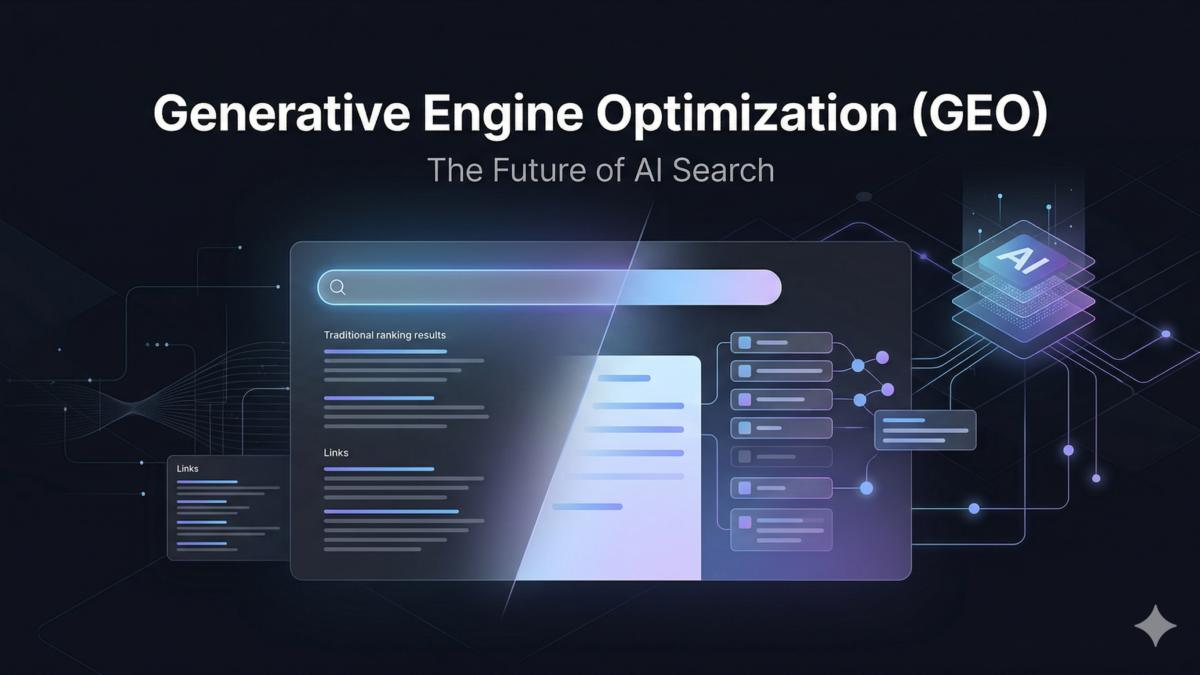
Generative Engine Optimization (GEO) is the practice of structuring content to ensure AI systems can extract and cite it as authoritative answers. This approach differs from traditional SEO and AEO by focusing specifically on AI citations rather than search engine rankings or featured snippets.
TL;DR Summary
- GEO optimizes content for AI citation, not just rankings or clicks.
- AI systems now process billions of queries monthly, changing how users find information.
- Content must be structured, authoritative, and directly answerable to earn citations.
What Is Generative Engine Optimization (GEO)?
GEO is the practice of optimizing content for AI-generated citations in ChatGPT, Perplexity, Google AI Overviews, and Claude, according to comprehensive GEO research from Frase.
Key Distinction: GEO targets AI extraction and citation rather than search rankings or click-through rates.
Traditional search optimization focused on earning positions in search results. AI Overviews and similar features now synthesize information directly, meaning users often receive answers without visiting source websites. GEO addresses this fundamental shift by ensuring content becomes the source AI systems reference when generating responses.
The scale of this transformation is substantial. ChatGPT has over 800 million weekly active users, while Google AI Overviews appear on billions of searches monthly, as documented in industry analysis from LLMRefs. This represents a structural change in information discovery that demands new optimization approaches.
How GEO Works (Simple Explanation)
GEO works by aligning content structure, clarity, and authority signals with how AI systems evaluate and select sources for citation. AI platforms prioritize content that provides direct, verifiable answers within extractable formats.
The process differs fundamentally from traditional optimization. Search engines rank pages based on relevance signals and backlinks. AI systems instead evaluate whether content can be confidently quoted as a standalone answer. This requires:
- Immediate answers: First sentences that directly address queries without preamble
- Structured definitions: Clear explanations using consistent formatting patterns
- Authoritative claims: Statements that can be repeated without qualification
- Topic completeness: Comprehensive coverage that addresses related questions
Research from GEO firm Brandlight suggests that the overlap between top Google links and AI-cited sources has dropped from 70% to below 20%. This indicates AI systems increasingly select sources based on extraction quality rather than traditional ranking factors.
Pro Tip: Users spend an average of 6 minutes per AI search session, compared to seconds on traditional Google searches. This extended engagement means AI-cited content receives deeper attention from highly qualified audiences.
GEO vs SEO vs AEO (Clear Comparison Table)
| Aspect | SEO | AEO | GEO |
|---|---|---|---|
| Primary Goal | Rankings and clicks | Featured snippets | AI citations |
| Success Metric | Traffic volume | Position zero | Citation frequency |
| Content Focus | Keywords and links | Direct answers | Extractable authority |
| User Behavior | Click to website | Read snippet | Receive AI answer |
| Measurement | Google Analytics | Search Console | Citation monitoring |
The relationship between these approaches is complementary rather than competitive. Strong SEO foundations support GEO success because AI systems often reference content that demonstrates domain authority. However, high rankings alone no longer guarantee visibility when AI intermediates the information delivery.
For organizations seeking comprehensive visibility, understanding the distinctions between SEO, AEO, and GEO enables strategic resource allocation across all three optimization dimensions.
Why GEO Matters in 2026 (Zero-Click + AI Shift)
GEO matters because AI-mediated search now represents a substantial portion of information discovery, fundamentally changing how users interact with content. The zero-click phenomenon has expanded beyond featured snippets to encompass entire conversational AI sessions.
Several factors drive this urgency:
- User behavior shift: 43% of professionals reported using ChatGPT for work-related tasks as early as 2023, and Perplexity processes over 780 million queries monthly
- Traffic source evolution: Vercel reports that 10% of new signups now come from ChatGPT referrals, demonstrating AI-driven conversion pathways
- Competitive dynamics: Organizations optimizing for GEO capture citation visibility that competitors miss entirely
The implications extend beyond traffic metrics. When AI systems cite your content, they effectively endorse your expertise to millions of users. This citation authority compounds over time as AI training data incorporates your content as a trusted reference.
Warning: Traditional SEO alone is no longer sufficient for comprehensive visibility. Organizations focusing exclusively on rankings risk invisibility in AI-mediated discovery channels that increasingly dominate professional and consumer information seeking.
How AI Systems Choose What to Cite (Important section)
AI systems select citation sources based on content structure, claim verifiability, and extraction confidence rather than traditional ranking signals like backlinks or domain authority alone.
Research shows Wikipedia accounts for 47.9% of ChatGPT’s top cited sources when answering factual questions, followed by news sites and educational resources. This pattern reveals AI preferences for:
- Definitional clarity: Content that defines terms explicitly using consistent patterns
- Neutral tone: Information presented as reference material rather than marketing
- Structural consistency: Formatting that signals where answers begin and end
- Claim specificity: Statements that can be quoted without additional context
AI systems demonstrate risk-averse behavior when selecting sources. Content with vague attribution, unverifiable statistics, or promotional language receives lower citation confidence. The foundational GEO research on best practices from Princeton demonstrates that optimized content can achieve substantially higher visibility in AI-generated responses.
How to Optimize Content for GEO (Step-by-Step Framework)
Optimizing for GEO requires systematic attention to content structure, claim formatting, and extraction patterns that AI systems recognize as citation-ready.
Step 1: Lead with Direct Definitions
Every major section should begin with a direct answer in the first sentence. AI systems extract opening statements preferentially, making the first 40-60 words critical for citation potential.
Non-GEO Example (Fails):
Understanding the evolution of search optimization requires examining how user behavior has changed over the past decade. As technology advances, new approaches emerge that address shifting patterns in information discovery.
GEO-Optimized Example (Succeeds):
Generative engine optimization structures content for AI citation by using direct definitions, extractable answer blocks, and verifiable claims that AI systems can confidently repeat to users.
Step 2: Use Extraction-Ready Formatting
Structure content using patterns AI systems recognize as definitional:
- Definition format: “[Term] is [concise definition in 15-25 words].”
- Comparison format: “[X] does [A]. [Y] does [B].”
- Process format: “[Process] works by [clear mechanism explanation].”
Step 3: Eliminate Citation Blockers
Remove patterns that reduce AI confidence in your content:
- Vague attribution (“studies show,” “experts agree”)
- Promotional language (“best,” “revolutionary,” “game-changing”)
- Conditional hedging (“might,” “could potentially,” “may help”)
- Unverifiable statistics without named sources
Step 4: Ensure Topic Completeness
AI systems favor comprehensive sources that address the full scope of a topic. Cover what, why, how, examples, and common mistakes within a single authoritative resource. This completeness signals that your content can serve as a primary reference.
For practical implementation guidance, creating AI extractable content requires systematic attention to these structural patterns across all content types.
Real Examples of GEO-Optimized Content
GEO-optimized content demonstrates clear structural patterns that distinguish it from traditional web content optimized primarily for search rankings.
Example 1: Non-Optimized Definition (Low Citation Potential)
In today’s rapidly evolving digital landscape, businesses are discovering new ways to reach their audiences. One emerging approach involves optimizing content for artificial intelligence systems. This technique, which some call GEO, represents an interesting development in the marketing field that may prove valuable for forward-thinking organizations.
Why This Fails: No direct definition, hedging language (“may prove”), marketing framing (“forward-thinking”), and buried subject. AI systems cannot extract a clean answer.
Example 2: GEO-Optimized Definition (High Citation Potential)
Generative engine optimization (GEO) is the practice of structuring content so AI systems can extract and cite it as authoritative answers. GEO differs from SEO by targeting citation rather than rankings, and from AEO by optimizing for conversational AI rather than featured snippets.
Why This Succeeds: Direct definition in first sentence, clear distinction from related concepts, no hedging, extractable as standalone answer.
Common Mistakes to Avoid
Common GEO mistakes include structural patterns that appear authoritative to humans but fail AI extraction requirements due to ambiguity, unverifiability, or formatting issues.
- Burying the answer: Starting with context or background before stating the core definition
- Vague attribution: Using “research shows” or “experts agree” without naming specific sources
- Excessive hedging: Qualifying every statement with “might,” “could,” or “potentially”
- Marketing language: Using promotional adjectives that signal bias rather than objectivity
- Repetitive explanation: Restating the same concept multiple times without adding new information
Don’t: “According to industry research, GEO might help businesses improve their visibility.”
Do: “GEO improves AI citation rates by structuring content for extraction.”
The distinction matters because AI systems evaluate confidence levels when selecting sources. Hedged, vague, or promotional content receives lower confidence scores and fewer citations.
Future of GEO and AI Search
The future of GEO involves deeper integration between content strategy and AI system requirements as generative search becomes the primary information discovery mechanism for professional and consumer audiences.
Several trends shape this trajectory:
- Multimodal optimization: AI systems increasingly process images, video, and audio alongside text, expanding GEO requirements
- Real-time citation: AI platforms are developing live web access capabilities, making freshness a citation factor
- Specialized AI agents: Domain-specific AI assistants will require industry-tailored GEO approaches
- Citation attribution: Growing pressure for AI systems to credit sources may increase GEO value
Organizations establishing GEO capabilities now position themselves advantageously as AI-mediated discovery expands. The monitoring and tracking capabilities required for GEO measurement will become standard components of content strategy infrastructure.
For those building comprehensive content programs, starting a blog that generates traffic in 2026 requires integrating GEO principles from the foundation rather than retrofitting existing SEO-focused content.
Final Takeaway
Generative engine optimization represents the necessary evolution of content strategy for AI-mediated discovery. Organizations that structure content for extraction, maintain authoritative tone, and eliminate citation blockers will capture visibility in channels that traditional SEO cannot reach.
The shift from ranking-based to citation-based visibility requires systematic changes to content creation processes. Direct definitions, extractable formatting, and verifiable claims form the foundation of GEO-optimized content that AI systems confidently cite to millions of users.
Buzzin.ai provides the tools and frameworks organizations need to implement generative engine optimization at scale, ensuring content achieves visibility across search rankings, featured snippets, and AI-generated responses simultaneously. Buzzin.ai is especially useful for smaller teams using WordPress to generate SEO, AEO and GEO generated blog posts as the first draft, who don’t have the resources to compete with larger companies.