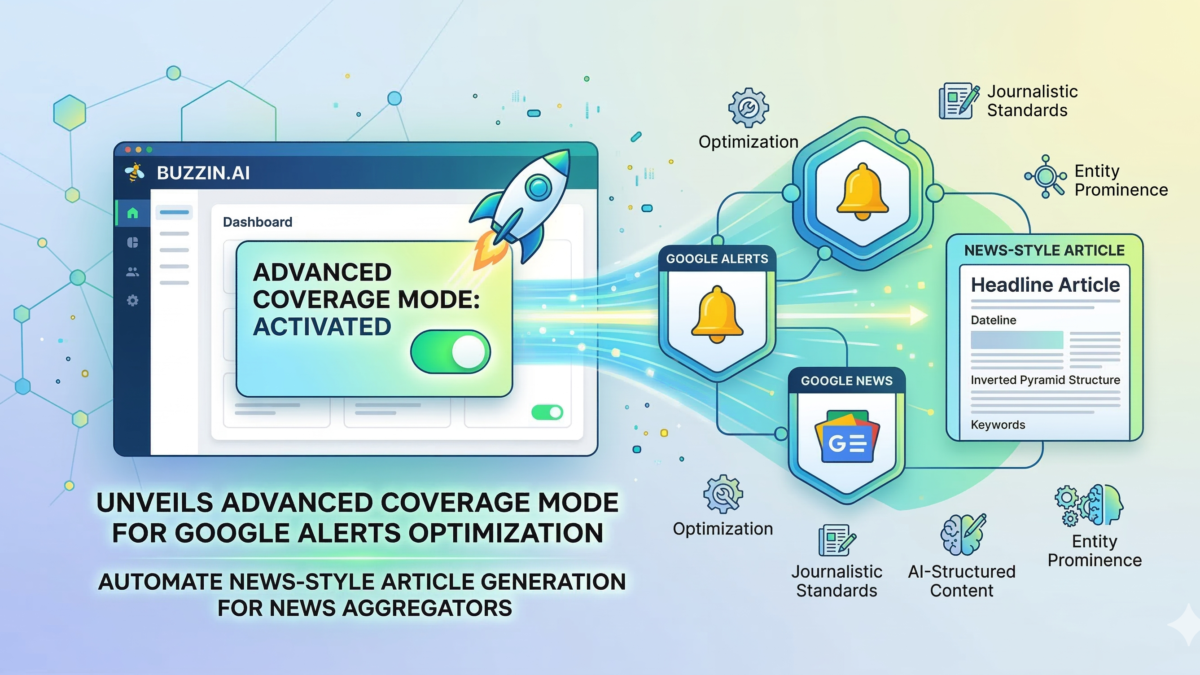
San Francisco, CA — May 15, 2026 — This week, Buzzin.ai unveiled its Advanced Coverage Mode feature, a significant advancement in Google Alerts optimization that enables content publishers to generate news-style articles specifically formatted for Google News and Google Alerts inclusion. The feature addresses a critical gap in content generation platforms by automating the creation of properly structured coverage content that meets journalistic standards and search engine requirements.
Buzzin.ai Unveils Advanced Coverage Mode for Google Alerts Optimization
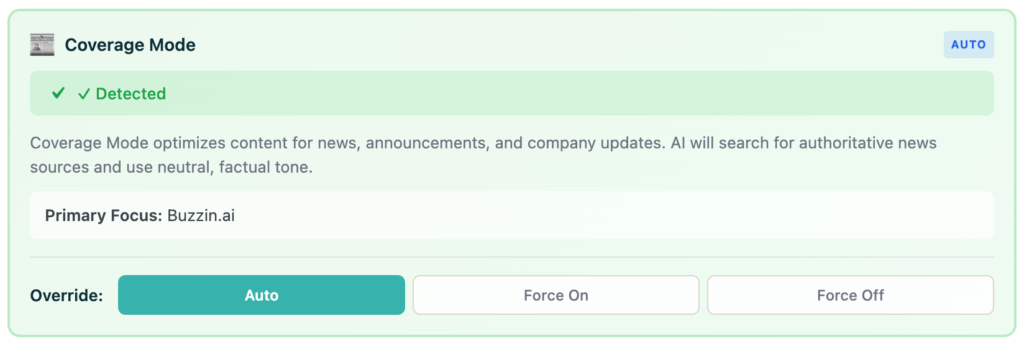
The Advanced Coverage Mode represents Buzzin.ai’s response to growing demand from content publishers seeking visibility in Google News and Google Alerts ecosystems. According to brand tracking research, more than 80 percent of consumers research a brand online before making a purchase decision, making news visibility increasingly valuable for organizations.
The feature automatically structures content using the inverted pyramid format preferred by news aggregators, placing the most critical information in opening paragraphs while distributing supporting details throughout subsequent sections. This structural approach aligns with how Google News algorithms evaluate and prioritize content for distribution.
Buzzin.ai’s implementation includes automatic dateline generation, temporal marker insertion, and entity prominence optimization. These elements are essential for Google Alerts optimization because the system relies on specific formatting patterns to identify and categorize news content accurately.
Technical Specifications and Integration Capabilities
The Advanced Coverage Mode feature introduces several technical innovations designed to improve content performance in news aggregation systems. The platform now generates content with configurable word count targets ranging from 600 to 1,500 words, with the optimal range for Google Alerts pickup identified as 800 to 1,000 words based on platform testing.
Integration capabilities extend to WordPress and other content management systems through existing Buzzin.ai connections. Publishers can configure automatic formatting rules that ensure consistency across all coverage content, maintaining the journalistic standards required for AI extractable content optimization.
The system incorporates Rank Math and Yoast SEO compatibility, automatically positioning focus keywords at the beginning of titles and within opening sentences. This integration addresses a common challenge publishers face when attempting to balance news formatting requirements with search engine optimization best practices for Google Alerts optimization.
Data processing capabilities include real-time keyword density monitoring, ensuring content maintains the 0.5 to 1.5 percent density range recommended for news content. The platform alerts users when keyword usage falls below optimal thresholds, preventing common optimization errors that reduce Google News visibility.
Industry Context and Market Positioning
The release of Advanced Coverage Mode positions Buzzin.ai within a competitive landscape that includes established monitoring tools and emerging AI content platforms. As noted in industry analysis of Google Alerts alternatives, the growing importance of social media mentions and real-time monitoring has created demand for more sophisticated content generation tools.
Traditional Google Alerts functionality, while free and accessible according to SEO monitoring guides, presents limitations for businesses with high-volume mention requirements. The Advanced Coverage Mode addresses these gaps by generating content specifically optimized for the platforms where Google Alerts sources its information.
Content publishers have historically struggled to produce news-formatted articles at scale while maintaining the quality standards required for Google News inclusion. The feature automates structural elements that previously required manual formatting expertise, including proper attribution formatting, source citation placement, and paragraph length optimization.
Market research indicates that organizations investing in news-style content visibility experience measurably higher brand recognition compared to those relying solely on traditional SEO approaches. This finding has driven increased interest in tools that facilitate Google Alerts optimization without requiring dedicated journalism resources.
Impact on Content Publishers and SEO Professionals
The Advanced Coverage Mode feature creates immediate opportunities for content publishers seeking expanded distribution channels. Organizations can now generate coverage content for product announcements, company news, and industry developments with formatting that meets Google News editorial standards.
SEO professionals benefit from integrated keyword optimization that maintains news formatting integrity. The platform prevents common mistakes such as keyword stuffing in headlines or inappropriate use of promotional language that would disqualify content from news aggregation. Publishers can explore comprehensive keyword analysis strategies to maximize their coverage content performance.
Short-term benefits include reduced content production time and improved consistency across coverage articles. Publishers report that manual news formatting typically requires 30 to 45 minutes per article, while the automated system produces properly formatted content in under five minutes.
Long-term implications extend to brand visibility and authority building. Consistent presence in Google Alerts results establishes organizations as news sources within their industries, potentially influencing how search algorithms evaluate overall domain authority for Google Alerts optimization purposes.
Challenges remain for publishers operating in highly competitive news environments. While the feature optimizes formatting and structure, content quality and newsworthiness remain editorial decisions that require human judgment. The platform provides tools rather than replacing editorial expertise.
SEO Benefits of Optimized Alert Coverage
Google Alerts optimization through properly formatted coverage content delivers measurable SEO advantages beyond direct news visibility. Content that appears in Google Alerts often receives secondary distribution through email notifications, RSS feeds, and third-party aggregation services.
Improved keyword tracking capabilities emerge when coverage content ranks for news-related queries. Publishers gain visibility for time-sensitive searches that traditional evergreen content cannot capture effectively. Understanding AI Overviews and their distinction from featured snippets helps publishers optimize for multiple search result formats simultaneously.
Enhanced competitor analysis becomes possible when organizations monitor their own coverage content performance alongside competitor mentions. The feedback loop between content generation and alert monitoring enables iterative optimization of coverage strategies.
Real-time insights support agile content responses to industry developments. Publishers can generate properly formatted coverage content within hours of news events, capturing search traffic during peak interest periods when query volume is highest.
Future Developments and Platform Roadmap
Buzzin.ai indicated that additional enhancements to the Advanced Coverage Mode are planned for subsequent releases. Expected features include expanded template libraries for different news content types, including press release formatting and event coverage structures.
User feedback integration will drive iterative improvements to the feature set. The platform has established channels for publishers to request specific formatting options and report issues with Google News inclusion rates. Organizations focused on building blogs that generate consistent traffic will benefit from these ongoing optimizations.
Potential AI integration may enhance headline generation and lead paragraph optimization in future versions. The company stated that machine learning models trained on successful Google News content could improve automated suggestions while maintaining the journalistic standards required for news aggregation.
Enhanced analytics capabilities are expected to provide publishers with detailed performance data on coverage content. Planned metrics include Google Alerts pickup rates, secondary distribution tracking, and comparative analysis against non-optimized content performance.
Strategic partnerships with news monitoring services may expand distribution channels for coverage content. These integrations would potentially increase the reach of properly formatted articles beyond Google’s ecosystem into specialized industry monitoring platforms.
Implementation Recommendations for Publishers
Publishers seeking to leverage the Advanced Coverage Mode for Google Alerts optimization should establish consistent content calendars that align with news cycles in their industries. Regular coverage content production maintains visibility in alert results more effectively than sporadic publishing patterns.
Proper entity identification ensures that coverage content triggers relevant Google Alerts for target audiences. Publishers should verify that company names, product names, and industry terms appear prominently in headlines and opening paragraphs where alert algorithms prioritize content scanning.
Quality control processes remain essential despite automation capabilities. Editorial review of generated content ensures accuracy, appropriate tone, and newsworthiness before publication. The feature optimizes format rather than replacing editorial judgment on content substance.
Integration with existing SEO and AEO strategies maximizes the value of coverage content investments. Publishers should coordinate news-style content with broader content marketing initiatives to maintain consistent messaging across all distribution channels.
Performance monitoring through Google Search Console and third-party analytics tools enables optimization of coverage content strategies over time. Publishers should track which content types and topics generate the strongest Google Alerts visibility to inform future content planning decisions.