
Key Takeaways
- Topical authority outranks individual keyword targeting in AI-driven search environments.
- A single pillar page supported by 15-30 subtopic articles forms an effective cluster.
- Keyword-to-intent mapping aligns each article with specific user search stages.
- Internal linking architecture reinforces topical relationships across the cluster.
- Share-of-voice and AI citation frequency measure authority beyond rankings alone.
Why Topical Authority Outranks Keyword Targeting in 2026
Topical authority outranks keyword targeting because AI-driven search systems evaluate the depth and breadth of subject coverage rather than isolated page relevance. Google’s Helpful Content signals and generative engines like ChatGPT and Perplexity reward sites demonstrating comprehensive expertise across related subtopics. The shift reflects fundamental changes in how search operates. According to comprehensive SEO research, 92% of all Google searches are long-tails, meaning authority is built by addressing the full spectrum of user questions within a niche rather than optimizing for head terms alone. Strong topical authority can cause lesser-known websites to outrank more established players, including Amazon and Wikipedia, when the smaller site demonstrates superior topical depth. For WordPress publishers, this represents an opportunity. A focused cluster strategy enables Avoid Ranking Without Clicks: Understanding the New Reality by building the kind of comprehensive coverage that AI systems cite as authoritative sources.How to Build Authority on WordPress Through Content Clusters
To build authority on WordPress through content clusters, select one pillar topic broad enough to support 15-30 subtopic articles, map supporting keywords to user intent, and implement hub-and-spoke internal linking between the pillar page and every cluster article. The process begins with pillar selection. A viable pillar topic must be broad enough to sustain extensive coverage yet specific enough to define clear boundaries. According to Machined’s content cluster guide, if a topic would require at least 10 to 15 distinct articles, it qualifies as a cluster topic. Pillar pages tend to be longer than typical blog posts, often 2,000 to 4,000 words, because they establish the scope of the entire topic. Once the pillar is defined, map 15-30 supporting subtopics. Clickcentric’s topical authority research recommends a minimum of 5-7 articles per cluster for basic authority, with 15-30 articles covering every subtopic, question, and comparison for competitive topics. This builds authority on WordPress by casting a wider semantic net across the topic space.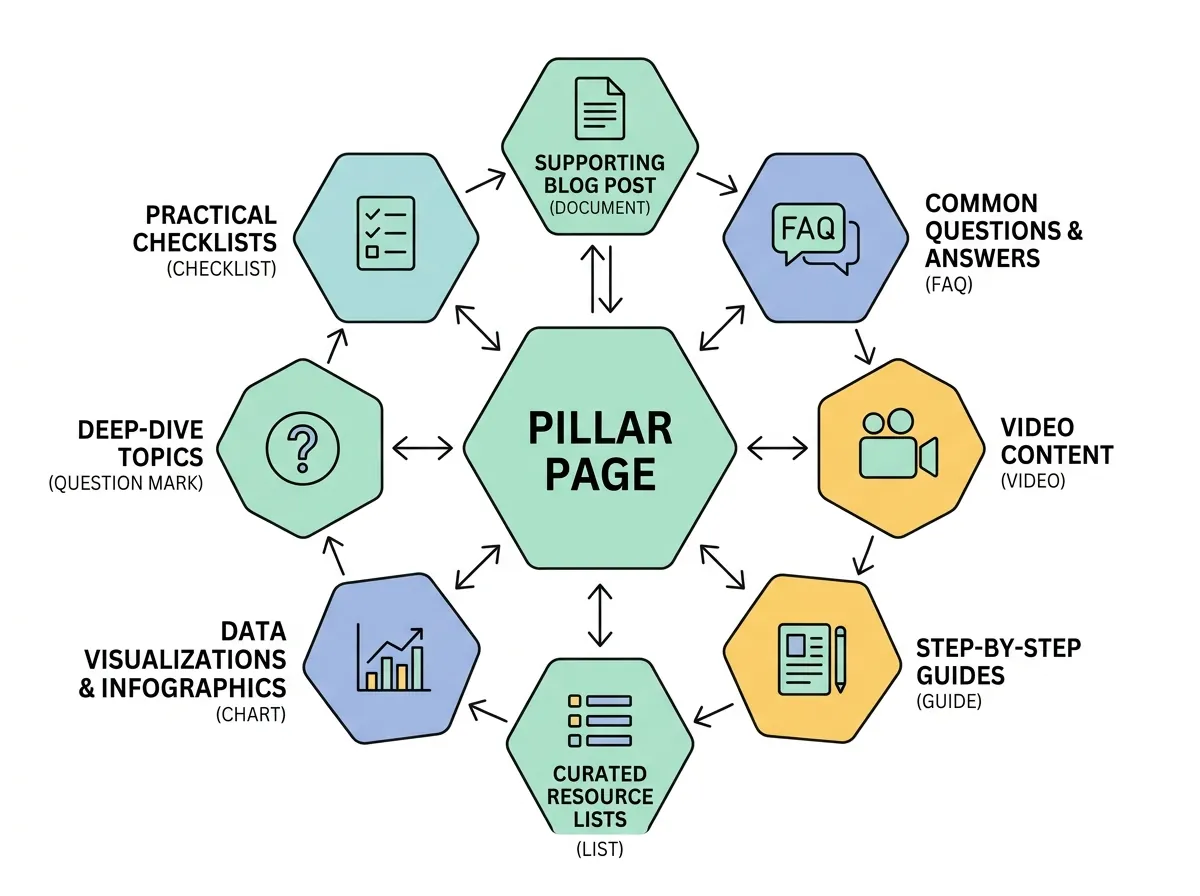
The Cluster Blueprint: A Worked Example
Consider a cluster built around “home solar” as the pillar. The pillar page serves as the central hub, a 3,000-word comprehensive guide covering solar fundamentals. Supporting subtopics branch outward:- Educational spokes: “How solar panels work,” “Types of solar panels,” “Solar inverter basics”
- Financial spokes: “Solar panel cost breakdown,” “Federal solar tax credit,” “Solar financing options”
- Decision spokes: “Solar vs grid electricity,” “Best solar companies,” “Solar panel warranties explained”
- Implementation spokes: “Solar installation process,” “Solar permit requirements,” “Maintaining solar panels”
Keyword-to-Intent Mapping for Cluster Depth
Keyword-to-intent mapping assigns each subtopic article to a specific stage of user intent, informational, navigational, commercial, or transactional, ensuring the cluster addresses the complete decision journey rather than duplicating coverage. Effective mapping begins with categorizing target queries by search intent. Informational queries (“how do solar panels work”) require educational content with clear explanations. Commercial investigation queries (“best solar panels 2026”) demand comparison articles with structured evaluation criteria. Transactional queries (“solar panel installation quote”) warrant conversion-focused content with local specificity. The Essential Strategies to Optimize Your Content: Proven Insights resource provides detailed frameworks for this process. This intent-first approach prevents keyword cannibalization, where multiple articles compete for identical queries, while ensuring comprehensive coverage. Tools including Google Keyword Planner, Ahrefs, and SEMrush surface the long-tail variations that comprise the majority of search volume, allowing publishers to identify gaps in their cluster coverage systematically.Internal Linking Architecture for Authority Reinforcement
Internal linking architecture reinforces topical authority by creating a clear hub-and-spoke structure where the pillar page links to every cluster article, each cluster article links back to the pillar, and semantically related cluster articles cross-link horizontally using descriptive anchor text. On WordPress specifically, this architecture is reinforced through three native features: categories, tags, and contextual internal links. Create a dedicated category matching the pillar topic and assign every cluster article to that category. Use tags for subtopic dimensions that cut across multiple clusters. Most importantly, implement contextual internal links within article body content, not merely in sidebars or navigation, as contextual links carry substantially greater authority weight. Anchor text selection requires strategic precision. Vary anchor text across exact-match, partial-match, and descriptive variations to signal topical relevance without triggering over-optimization filters. The AI Trends in WordPress: Essential Tools to Boost overview documents how modern AI-assisted editing tools can streamline this linking process at scale.Publishing Cadence and Cluster Completion Velocity
Publishing cadence affects topical authority because search systems reward sustained subject-matter commitment. Completing a 15-article cluster within 4-8 weeks signals concentrated expertise more effectively than publishing the same articles sporadically across 12 months. Manually building a 15-article cluster takes a content team 4-6 weeks, according to Clickcentric’s analysis. This velocity challenge is where AI-assisted content production becomes strategically relevant. Platforms like Buzzin enable publishers to batch-produce cluster content, generating pillar and supporting articles in coordinated sessions that maintain topical consistency across the entire cluster. The Organic Lead Generation Surges in 2026: How WordPress analysis documents how accelerated cluster deployment correlates with faster organic traffic growth.Frequently Asked Questions
What if I struggle to find relevant subtopics for my cluster?
Utilizing keyword research tools and analyzing competitor content can help identify relevant subtopics for your cluster. Focus on related keywords and questions that your target audience is searching for to build comprehensive content that enhances your topical authority on WordPress.
Is it true that internal linking can negatively impact user experience?
Internal linking does not inherently harm user experience; in fact, it can enhance navigation and provide additional context to users. However, overusing internal links or linking to irrelevant content can confuse users, so it’s essential to maintain a balanced and logical linking strategy.
When should I be concerned about my site’s authority declining?
You should be concerned about your site’s authority declining if you notice a consistent drop in organic traffic, keyword rankings, or engagement metrics. Regularly monitoring these indicators allows you to identify issues early and take corrective action to maintain your authority on WordPress.
Why isn’t my content ranking despite following best practices?
Content may not rank despite following best practices due to factors such as high competition, insufficient keyword optimization, or lack of backlinks. Additionally, content that fails to meet user intent or lacks engagement can struggle to achieve higher rankings.
How do I handle outdated content in my clusters?
Handling outdated content involves reviewing and updating it to ensure accuracy and relevance. You can either refresh the content with new information or consolidate it with related articles to maintain a cohesive content cluster and improve your topical authority on WordPress.