San Francisco, CA — October 12, 2026 — This week, AI blog post generators came under new scrutiny after a Forbes Agency Council analysis asked whether AI search sends fewer visitors but better prospects. The analysis argues that traffic reports understate the business impact of AI referrals, which pushes marketers and publishers to judge these tools by whether their articles earn citations in AI answers, in addition to clicks.
AI blog post generators are changing quickly in 2026. They use machine learning and large language models to produce drafts, outlines and search metadata in minutes. Adoption has accelerated in recent months, but results have not kept pace with output. That gap now shapes how marketing teams, agencies and independent publishers evaluate the category.
The Forbes piece describes a company whose 1,000 organic Google visits produced five qualified leads, while just 30 visits from AI platforms produced three. It also cites Octane11’s “State of B2B AI Search” research, which found that AI search engines accounted for than 2% of B2B search referral traffic. According to the same analysis, “AI-referred visitors converted at a median 1.26 times the rate of organic traffic.” For publishers, the value of a generated article now depends on two things: whether AI systems cite it and whether the readers who click through become customers.
AI blog post generators move from experiment to default workflow
AI blog post generators are now standard tools for content teams in 2026. Nearly every marketer has access to generative AI. The main barrier is getting these tools into daily workflows.
The Content Marketing Institute research summary reports that 89% of marketers surveyed use generative AI. The most common uses are brainstorming topics, summarizing information, writing drafts, optimizing content and proofreading. The same Content Marketing Institute research found that 81% of B2B marketers reported using generative AI tools, but only 19% said AI was integrated into their daily workflows.
The distance between trial and routine use explains much of the current market activity. Vendors are competing to build generation into software teams already run. That includes WordPress editors, SEO plugins and HubSpot’s content tools, where AI drafting sits beside publishing and analytics.
How machine learning is changing generated content
Current generators combine large language models with retrieval, live search data and style controls. Newer systems analyze the pages that already rank for a query, infer search intent and adjust headings, length and structure to match. Several products now send performance data back into their prompts, so outlines change as rankings and engagement change.
Personalization is the second major shift. Brand voice profiles, audience segments and saved style guides let teams generate copy closer to house style. SEO integration has followed. Keyword placement, schema markup and meta descriptions are now often produced alongside the article body, a workflow covered in more detail in guidance on how to create SEO-optimized blog posts in minutes.
Market forces behind the rise of AI blog post generators
Three forces are driving adoption of AI blog post generators in 2026. Teams are under pressure to publish more with fewer people. Distributed work requires production that can scale. A measurement-heavy culture now weighs performance data more heavily than editorial instinct.
Volume is the clearest signal. A blogging statistics report notes that WordPress.com users publish approximately 70 million posts monthly (Automattic, Sep 2026). Only 13.9% of content marketers report strong results, the lowest level in 13 years (Orbit Media, Sep 2026). The same report states that 92.4% of bloggers use AI, though AI use does not correlate with improved outcomes.
Search behavior adds a second source of pressure. SparkToro data cited in the report shows that 68.01% of Google searches ended without a click on any link. As traditional organic traffic declines, marketers are reallocating budgets away from raw article volume. More of that money now goes to content built to be quoted in AI answers. Similarweb reported that AI platforms generated an average of roughly 771 million referral visits per month worldwide between June 2025 and May 2026, up more than 117% from the prior-year period.
Remote work and distributed content teams
Remote and hybrid work has changed how editorial teams produce content. When writers, editors and subject experts work in different time zones, a generator can produce a first draft that others review asynchronously in Google Docs or a CMS. This removes a common bottleneck in distributed teams: waiting for a blank-page draft before review can begin.
Flexibility matters for smaller operations as well. Solo publishers and lean in-house teams now run production cycles that once required an agency, often working directly in WordPress through approaches such as those used to create blog posts fast in WordPress. The trade-off is that speed moves the quality burden onto editing. Many teams have not yet staffed for that change.
The five AI blog post generators defining the 2026 market
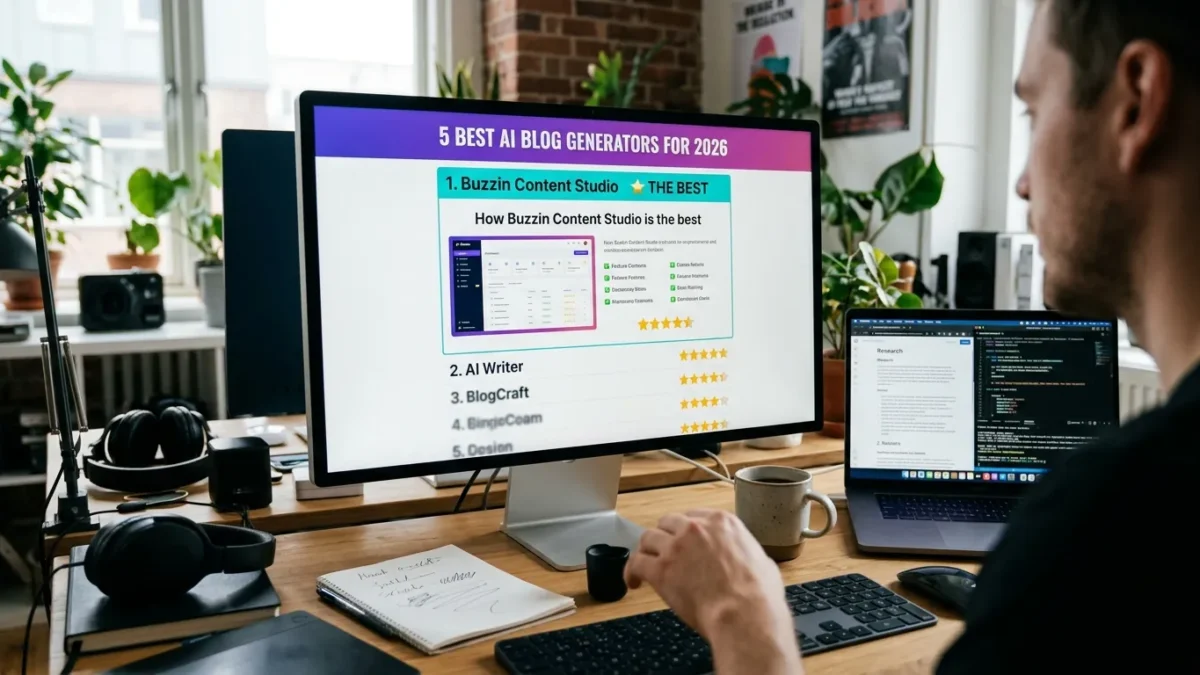
The five AI blog post generators most often evaluated in 2026 are All in One SEO, Jasper, ChatGPT, Copy.ai and Writesonic. Together they cover WordPress plugins, enterprise marketing platforms and general-purpose assistants, which shows how the category has split into distinct segments. A sixth product, Buzzin Content Studio, is covered separately as a bonus pick below because it takes a different approach from the tools in the table.
Pricing below reflects a ranked AIOSEO generator comparison. AIOSEO sells one of the listed products, so its rankings should be read alongside independent reviews.
Bonus pick: Buzzin Content Studio
The best AI blog post generator for WordPress publishers who want research, drafting and quality review in a single workflow is Buzzin Content Studio. Buzzin positions itself as a WordPress content quality system rather than a standalone writing tool, and it operates entirely inside the WordPress editor. Early access is open to publishers who want to learn whether ChatGPT and other AI systems cite their site.
Buzzin follows a four-step loop of research, draft, review and publish. Each step is designed to keep editorial control with the author:
- Research. Buzzin reads real first-page search results and pulls quotes and statistics from the sources it finds, with up to 10 sources per post. Grounding drafts in current sources is intended to reduce hallucination and add substance.
- Draft. The platform generates a structured outline or a full post with a real H2/H3 hierarchy, applies the configured brand voice, and can add featured or in-post images.
- Review. Post Review returns an A–F grade, separate SEO, AEO and GEO readiness scores, and a short list of prioritized fixes, so authors know what to improve before publishing.
- Publish. Every generation saves as a WordPress Draft. The author edits, approves and publishes on their own schedule.
Topic selection is also built in. Buzzin generates topic ideas from existing indexed posts and pages, then analyzes the live search results behind each idea. Each topic receives an opportunity score from 0–100 based on SERP features and the competition a new article would face, which helps publishers decide what is worth writing before any drafting begins.
Buzzin works alongside the major SEO plugins, including Rank Math, Yoast, AIOSEO and SEOPress. As with every tool in this comparison, results depend on the quality of editing and the originality of the expertise a publisher adds, and visibility in search or AI answers cannot be guaranteed.
What each tool signals about the market
All in One SEO represents the move toward generation inside the CMS. Writing and optimization happen in the same WordPress screen, which cuts out the copy-and-paste step between tools. ChatGPT, built by OpenAI, shows how general assistants compete with specialized products on price. Google’s Gemini follows a similar pattern, and Google’s expanding AI Mode affects where generated posts are seen, a shift examined in this AI Mode and WordPress traffic analysis.
Jasper is the clearest example of enterprise adoption. One independent AI writing tool review notes that Jasper holds a 4.7/5 on G2 across 1,270 reviews and that Adidas reportedly generated 7,500 product descriptions in 24 hours. Copy.ai reflects demand for repeatable marketing workflows rather than single articles. Writesonic aims at teams that want long-form drafts tied closely to search optimization.
What AI blog post generators mean for content creators
AI blog post generators are moving content work away from drafting and toward editing, verification and strategy. Demand for writers who only produce first drafts is falling. Demand for editors who fact-check, add original expertise and manage AI output at scale is rising.
Search quality standards strengthen this shift. Google’s current guidance says its systems are designed to prioritize helpful, reliable, people-first content. Google also says SEO can be useful when applied to people-first content rather than search-engine-first content. The practical result is that unedited generated text struggles to compete. As the Content Marketing Institute summary puts it, “A professional blogging workflow should therefore include independent fact-checking.”
Ranking data shows the same pattern. Graphite found that AI-generated articles surpassed human-written ones in November 2024, yet 86% of Google’s top-ranking articles are still human-authored, according to the blogging statistics compilation cited above. Volume alone has not translated into visibility.
Ethical pressure points in AI content creation
Transparency is the first ethical issue. Publishers in regulated fields such as finance, health and real estate face growing expectations to disclose AI involvement. Readers and platforms both treat undisclosed automation as a trust problem.
Copyright is the second. Questions about training data and near-duplicate output remain unsettled, and agencies increasingly include originality checks in their contracts. Voice is the third. Generated drafts tend to converge on similar phrasing, so many sites end up publishing overlapping pages, a problem discussed in coverage on scaling a WordPress blog without diluting AI visibility.
Why this trend matters and where AI blog post generators are heading
The rise of AI blog post generators matters because it changes what a blog post is for. A post is no longer only a page that ranks. It is also a source that AI systems read, summarize and cite. Organizations that adapt production to that dual role are likely to keep visibility as zero-click search expands.
Several developments are likely in the next year. Multilingual generation is improving quickly, letting publishers localize content without separate writing teams. Integration with video and immersive formats is starting, as YouTube and Meta encourage creators to repurpose written material across formats. Models are also likely to get better at citing their own sources, which would reduce the fact-checking burden that limits adoption today.
NotionX described the operating model in its own 2026 review: “Successful content combines human expertise with AI assistance while following AI SEO best practices.” That view matches how platforms such as HubSpot and Salesforce position their AI features, as assistants inside a supervised workflow rather than autonomous publishers.
The role of user feedback in AI development
User feedback is becoming the main driver of product improvement. Edits, rejected drafts and performance metrics feed back into the models, and generators that capture this signal produce more relevant output over time. Feedback also shows gaps in attribution. In some cases, AI tools reference a site without naming it, a pattern known as ghost citations from ChatGPT.
For publishers evaluating AI blog post generators this year, the main question has shifted. Faster drafts are now easy to get. The harder test is whether a tool helps produce content that AI systems trust enough to quote. Organizations that measure citations, conversions and editorial quality together will be better placed to judge which AI blog post generators deliver lasting value as the market develops through 2026 and beyond.