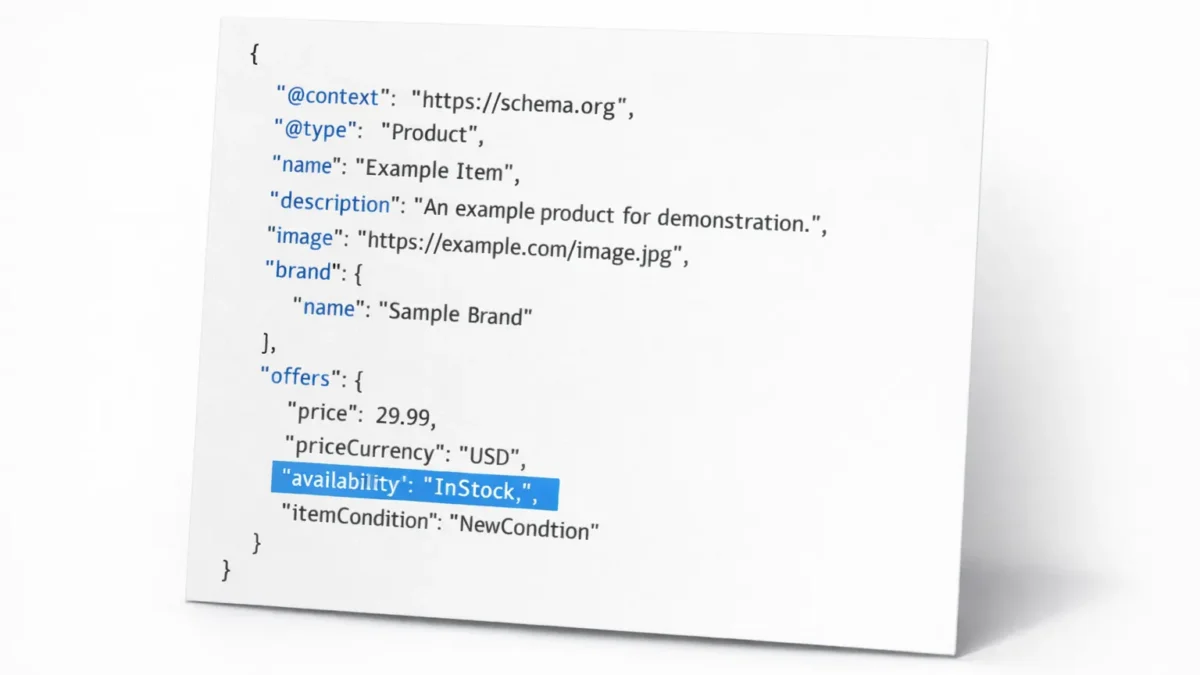
Schema markup is structured data added to WordPress pages in JSON-LD format that helps search engines and AI answer engines understand content, entities, and relationships, making pages eligible for citation in ChatGPT, Claude, Gemini, Perplexity, and Google AI Overviews. In 2026, seven JSON-LD types carry most of the weight: Organization, Article, FAQPage, HowTo, Product, BreadcrumbList, and Person/Author.
Key Takeaways
- Schema markup remains the highest-leverage structured signal for AI answer engine visibility in 2026.
- Organization schema with sameAs properties anchors entity identity across every AI engine.
- FAQPage and HowTo schema map directly to how AI engines extract direct answers.
- JSON-LD is the only practical format for scaling structured data across WordPress templates.
- Validation prevents silent failures that quietly remove pages from AI citation pools.
TL;DR: Schema Markup for AEO Summary
- Seven JSON-LD types cover 80% of AEO citation value.
- Organization plus Author schema establish entity trust signals.
- FAQPage and HowTo schema feed direct-answer extraction.
What Is Schema Markup and Why It Matters for AEO
Schema markup is a vocabulary of tags defined at schema.org that you add to a WordPress site to tell search engines and AI engines what your content is, who wrote it, and which entities it involves. For answer engine optimization, schema markup removes ambiguity so AI systems can extract and attribute answers with higher confidence.
AI engines including ChatGPT, Claude, Gemini, and Perplexity use schema as a primary source of structured information about entities, content, and relationships, per Mo Agency’s AEO schema analysis. Pages with comprehensive schema are cited more often and more accurately than pages without it, which is why schema is the single highest-leverage investment for answer-engine visibility in 2026 according to Kerkar Media’s schema guide.
The shift matters because answer engines are replacing the ten blue links with synthesized responses. Without structured data, large language models are forced to infer meaning and entity relationships from messy HTML, which reduces citation likelihood for any given page.
The Evolution Toward Entity-Based Search
Search has moved from keyword matching to entity resolution. Schema markup defines entities (your brand, your authors, your products) and the relationships between them, which is exactly what an AI engine needs to decide whether your page should be cited when a user asks “what does X company do?” or “who is the author behind Y guide?”
Which 7 JSON-LD Types Every WordPress Blog Needs
The seven JSON-LD types that matter most for WordPress blogs in 2026 are Organization, Article, FAQPage, HowTo, Product, BreadcrumbList, and Person (Author). FAQPage, HowTo, Article, Product, and Organization align directly with how AI systems extract and cite answers, per AirOps schema implementation research.
Across 40 client sites where comprehensive schema was rolled out between late 2024 and early 2026, Kerkar Media documented a median 38% lift in AI-engine citation rate within 90 days, and an 11% lift in organic impressions from rich results. Eighty percent of schema value comes from five core types, with BreadcrumbList and Person adding meaningful entity context on top.
How to Implement Article and Author Schema
Article schema needs the required properties (headline, datePublished, dateModified, author, publisher, image) plus an author block that links to a Person entity with sameAs values pointing to LinkedIn, X, and any professional profiles. The sameAs property on Organization schema is the most under-used high-impact schema element, and the same logic applies to Author entities.
Common pitfalls during implementation include omitting dateModified (which signals freshness to AI engines), using a generic “Admin” author rather than a real Person entity, and forgetting to nest the publisher Organization with a logo ImageObject.
Pro Tip: Every WordPress site needs Organization schema sitewide. It defines who you are as an entity, and it is the single most-cited schema type by AI engines when they answer “who is X” or “what does X do” prompts.
What Are the Most Common Schema Markup Mistakes
The most common schema markup mistakes on WordPress blogs are stacking multiple plugins that emit conflicting JSON-LD blocks, leaving validation errors unresolved for months, and failing to update schema when underlying content changes. Each error silently removes a page from AI citation pools.
A second category of failure: marking up content that is not actually present on the page. FAQ schema describing questions that do not appear in the visible HTML violates Google’s structured data guidelines and is treated as a quality signal by AI engines that cross-check schema against rendered content. Validation and template-based schema prevent these silent failures and keep structured data consistent as content scales.
Validation and Testing Tools That Matter
Three tools cover validation needs: Google’s Rich Results Test for eligibility checks, the Schema.org validator for raw JSON-LD syntax, and Google Search Console’s Enhancements report for site-wide error monitoring. Real-time validation inside the WordPress editor (available in Rank Math, Yoast, and Schema Pro) catches issues before publish rather than after.
Don’t: Run two SEO plugins simultaneously and let each emit its own Article and Organization schema.
Do: Pick one schema source, disable schema output in any secondary plugin, and verify a clean single JSON-LD block in the page source.
What to Avoid When Implementing Schema on WordPress
Avoid outdated schema formats like Microdata and RDFa for new implementations, schema that contradicts visible page content, and any schema added without a monitoring plan. JSON-LD is the most practical format for scaling structured data across templates without breaking layouts.
Avoid the temptation to add every available schema type to every page. Speakable, ClaimReview, and LiveBlogPosting have narrow legitimate uses; applying them broadly dilutes the entity signal and triggers manual review at Google. Keep schema honest, specific, and scoped to what each page actually contains.
Monitoring Schema Performance Over Time
Google Search Console’s Enhancements report surfaces errors and warnings per schema type. Pair that with monthly citation audits using tools that track ChatGPT and Perplexity mentions. If you want a structured approach to citation tracking, the AI citation audit framework walks through the exact checks worth running quarterly.
What Are the Future Trends in Schema Markup for AEO
The Ahrefs empirical study published on May 11, 2026, covering 1,885 pages that added JSON-LD between August 2025 and March 2026 against 4,000 control pages, reported +2.4% in Google AI Mode, +2.2% in ChatGPT, and -4.6% in Google AI Overviews. The takeaway from the Ahrefs schema study analysis is that schema produces no major uplift on its own; it works alongside crawlability and content quality.
That nuance matters. Schema markup is a means to an end, not the destination. For pages that are not being seen by AI systems at all, schema might still play a role in helping them get crawled, parsed, or indexed in the first place. Local business schema, conversational FAQ patterns optimized for voice search, and richer Product schema with review aggregates are the three growth areas worth investing in next.
Preparing for Conversational and Voice Queries
Voice and conversational AI queries reward FAQ schema with natural-language question phrasings. Write question fields the way users actually speak them, keep answer fields under 60 words, and ensure the answer is also visible on the page in the same wording.
Frequently Asked Questions
What edge cases should I consider when implementing schema markup?
Is it true that using too many schema types can harm SEO?
What are the warning signs that my schema markup is incorrect?
Why isn’t my schema markup showing up in search results?
How do I handle schema markup for multilingual websites?
Can schema markup improve my WordPress blog’s visibility in search engines?
Expert Recommendations for Schema Markup in 2026
The strongest schema markup programs share three habits: a quarterly audit of every schema type emitted sitewide, an entity graph that connects Organization, Person, and Product schema via sameAs and author properties, and disciplined removal of schema that no longer matches page content.
According to research from Data World cited by The Hoth, schema markup enables LLMs grounded in knowledge graphs to achieve 300% higher comprehension versus unstructured data, and pages with schema markup are 3x more likely to earn AI citations. The mechanism is straightforward: structured data tells the model what the page is about with zero inference cost.
For WordPress teams scaling content, schema implementation should be templated at the post-type level so that every new article, product, or landing page inherits the correct JSON-LD without manual intervention. Agencies managing multiple sites can apply the same templating approach across clients, as documented in this multi-site content scaling guide.
Warning: Adding schema markup to thin or low-quality content will not produce citations. Schema amplifies content quality; it does not substitute for it. Audit content depth before investing in structured data rollouts.
Schema markup in 2026 is foundational infrastructure for any WordPress blog that wants to be cited by AI answer engines. The seven JSON-LD types covered above (Organization, Article, FAQPage, HowTo, Product, BreadcrumbList, and Person) handle the majority of citation-worthy contexts, and disciplined implementation paired with quarterly validation separates sites that get quoted from sites that get ignored. The next frontier is entity graph completeness, where sameAs properties and author identity carry the weight that keyword targeting carried a decade ago.