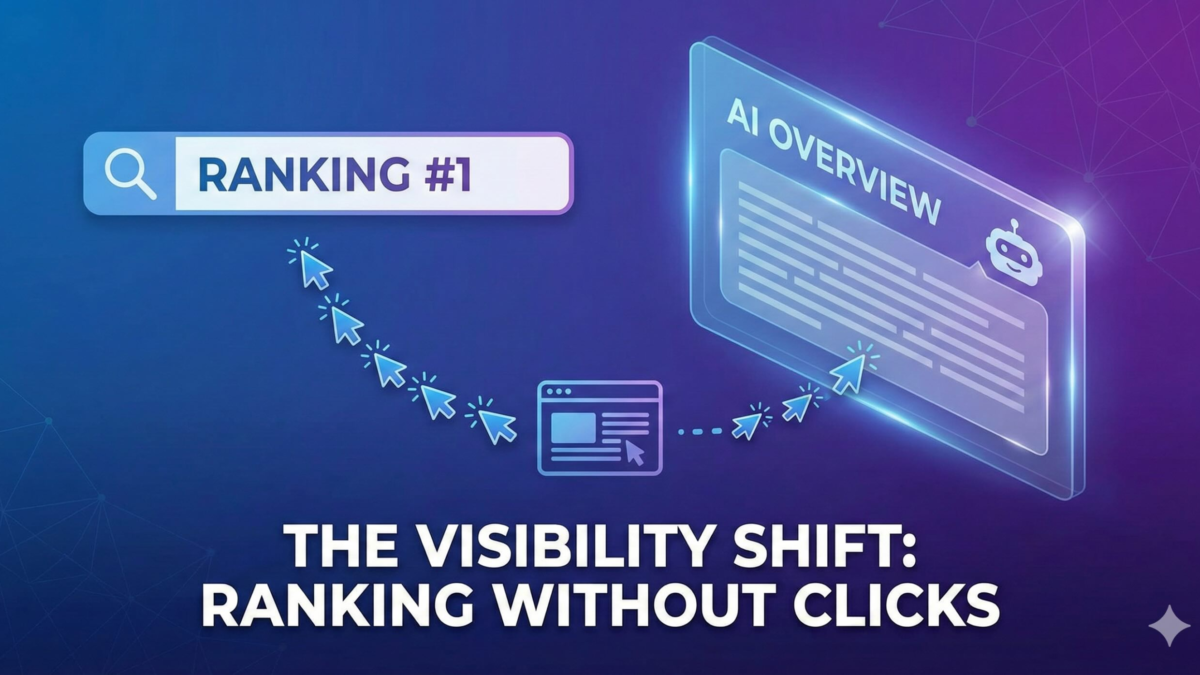
Ranking without clicks signifies a crucial visibility shift in search behavior, representing an evolution rather than a failure of your SEO strategy. With AI Overviews now driving nearly 60% of searches that end without traditional clicks, it is essential to understand this dynamic to adapt your strategies effectively. This change illustrates how users increasingly consume information directly from search results, enhancing brand presence and visibility even as direct traffic may fluctuate.
TL;DR: Ranking Without Clicks Summary
- Ranking without clicks indicates visibility success, not a failure of strategy.
- AI Overviews fulfill user queries directly within search results.
- Modern SEO requires a visibility-first approach beyond mere traffic metrics.
Answer engines and AI systems prefer content that: directly answers questions in the first 40-60 words, utilizes question-based headings, provides self-contained passages, and avoids vague qualifiers while making assertive claims.
What Does Ranking Without Clicks Actually Mean?
Ranking without clicks occurs when your content is prominently displayed in search results, yet users do not visit your website because their query is answered directly on the search page. This trend reflects changing user behavior and not the performance of your content.
The emergence of AI Overviews has fundamentally altered how users engage with search engines. As noted in Search Engine Land’s analysis, nearly 60% of searches resulted in no clicks in 2025, largely driven by AI Overviews. Users are increasingly provided with comprehensive answers without navigating away from the search interface.
Key Insight: If your non-branded impressions in zero-click positions are increasing alongside stable or growing direct traffic or branded search volume, you are observing the positive impact of SEO—not through traditional click pathways.
What Is an AI Overview?
An AI Overview is a search feature that provides users with a synthesized answer directly within the search results, generated by artificial intelligence and informed by multiple web sources. Instead of presenting a list of links alone, the system summarizes relevant information to address the user’s query immediately.
In platforms like Google Search, AI Overviews appear above or alongside traditional organic results and often include citations to source content. Their purpose is to reduce the need for follow-up searches by delivering concise, contextually relevant responses at the moment of intent.
AI Overviews differ from featured snippets in a key way:
-
Featured snippets extract a single passage from one source.
-
AI Overviews synthesize information across multiple sources into a unified response.
The Role of AI in Search Visibility
AI Overviews deliver synthesized answers by extracting information from multiple sources, decreasing the necessity for users to click through to individual websites. This does not reduce the value of your content; rather, it transforms how that value is communicated. Your expertise reaches users even when they do not visit your site directly.
Recognizing AI’s role is crucial for refining your optimization strategy. Rather than perceiving ranking without clicks as a lost opportunity, view it as brand exposure at scale. When AI systems frequently reference your content, you establish authority that can shape future searches and purchasing decisions.
What Are the Warning Signs When Ranking Without Clicks Becomes Problematic?
Ranking without clicks becomes concerning when visibility metrics increase but engagement indicators decline simultaneously, suggesting that your content may not resonate despite being displayed. Healthy zero-click visibility typically correlates with stable or increasing branded search and direct traffic.
Look for these specific patterns that indicate potential issues:
- Impressions increasing while CTR and branded searches decrease—this indicates visibility without significant impact.
- Declining average session duration among users who do click through.
- Reduced pages per session indicating lower engagement quality.
- Flat or declining direct traffic despite heightened search visibility.
Warning: Lower click-through rates alone do not signify a problem. The real concern arises when increases in visibility do not lead to measurable brand awareness or engagement improvements.
Key Metrics to Monitor
Monitor changes in CTR alongside branded search volume, rather than in isolation. A declining CTR paired with rising branded queries often signifies effective visibility—users see your content, recall your brand, and subsequently search for you directly. Additionally, keep an eye on bounce rates and session duration for users who do click through, as these metrics reveal content quality independent of volume.
What Are Common Misconceptions About Visibility and Clicks?
The most enduring misconception is that high rankings automatically ensure high traffic, while visibility and clicks have become increasingly decoupled in AI-driven search environments. Rankings denote potential reach, not guaranteed engagement.
Myth: Clicks are the only measure of SEO success.
Reality: Visibility plays a crucial role in brand awareness, trust-building, and future conversions even in the absence of immediate clicks. As SEO Site Checkup research indicates, visibility—not solely traffic—is now part of the ROI equation.
Myth: Ranking without clicks indicates content failure.
Reality: Your content may be succeeding by answering user queries so effectively that AI systems extract and feature it prominently. This is a recognition of content quality, not a failure.
Myth: Zero-click searches negatively impact all businesses equally.
Reality: Informational queries tend to have higher zero-click rates, while transactional queries often display stronger click-through patterns. The mix of queries you target significantly affects expected behavior.
Why These Misconceptions Persist
Traditional SEO metrics have long dominated discussions, creating entrenched expectations that traffic is the primary success indicator. Many analytics dashboards still emphasize clicks over visibility, perpetuating outdated measurement frameworks. Furthermore, the rapid integration of AI in search has outpaced widespread comprehension of its implications.
What Should You Do When Ranking Without Clicks Occurs?
When you encounter ranking without clicks, prioritize enhancing on-site engagement for visitors who do arrive while optimizing content for AI extraction and voice search responses. This dual approach captures value from both click-through traffic and zero-click visibility.
Effective strategies include:
- Optimize for voice search and AI responses—structure content with clear, extractable answers.
- Strengthen branded search presence—users who see your content in AI Overviews often search for your brand name later.
- Leverage social media to drive traffic through alternative channels.
- Create content that invites deeper engagement—tools, calculators, and interactive elements that AI cannot replicate.
For further insight into how traditional search optimization compares to answer engine optimization, our guide on Understanding SEO vs AEO: A Comprehensive 2026 Guide offers extensive frameworks for adapting your strategy.
Engagement Strategies to Implement
Utilize multimedia content—videos, infographics, and interactive elements—to engage users seeking experiences beyond text answers. Encourage user-generated content and feedback to foster community engagement that search results cannot replicate. These strategies create value that necessitates website visits to access.
Pro Tip: Companies that thrive in this environment will focus on creating irreplaceable experiences that enhance their search visibility rather than depending solely on it.
Why Might Your Strategy for Ranking Without Clicks Not Work?
Strategies often fail when they overlook algorithm changes favoring AI-generated responses or when content is not structured for extraction by answer engines. Ignoring user intent behind queries can also derail otherwise sound approaches.
Common pitfalls include:
- Continuing to optimize solely for traditional rankings without accounting for how AI systems process and display content.
- Neglecting to adapt content structure for featured snippets and AI Overview extraction.
- Overlooking mobile optimization—mobile users frequently encounter higher zero-click rates due to AI Overview prominence.
- Disregarding local SEO opportunities where click-through behavior often remains stronger.
Research from GTechMe’s analysis highlights that in a post-ranking world, ranking serves as the invitation—engagement is the main event. Focusing solely on rankings misses this pivotal shift.
Common Issues to Address
Neglecting mobile users presents a significant oversight, as mobile searches reveal AI Overviews more prominently. Ignoring local SEO opportunities also restricts your ability to capture high-intent queries where users continue to demonstrate strong click-through behavior. Address these gaps before concluding that your broader strategy has failed.
What Expert Tips Help Navigate Ranking Without Clicks?
Experts advocate for staying informed about AI advancements while testing content formats that deliver value beyond what AI systems can extract and showcase. Personalized, interactive content often fosters engagement that zero-click visibility cannot achieve alone.
Key recommendations include:
- Monitor Share of Search metrics—if specific page rankings decline but your overall Share of Search rises, your overarching SEO strategy is working effectively.
- Move beyond last-click attribution—this model is outdated for measuring contemporary search impact.
- Experiment with new distribution channels—broaden traffic sources beyond organic search.
- Engage audiences through personalized content that cultivates relationships over time.
According to Exploding Topics research, Google asserts that despite a decrease in clicks, their quality is on the rise. This suggests that users who do navigate to your site demonstrate higher intent and engagement potential.
Innovative Content Strategies
Leverage data storytelling to captivate users with insights that AI summaries cannot provide. Incorporate interactive elements—assessments, configurators, personalized recommendations—that necessitate website visits for full experiences. These tactics create defensible value in a landscape where basic information increasingly gets delivered without clicks.
Do: Craft content experiences that augment AI visibility—tools, community, and personalization.
Don’t: Assume that ranking without clicks signifies failure without analyzing branded search and engagement trends.
Definition: Ranking Without Clicks
Ranking Without Clicks: A search phenomenon where content appears prominently in results, yet users do not navigate to the website because their query is answered directly on the search page through AI Overviews or featured snippets.
Visibility-First SEO: The strategic transition from focusing solely on traffic to enhancing brand presence and visibility across search experiences, including zero-click environments.
Key Distinction: Ranking without clicks symbolizes a visibility shift in user behavior, not necessarily a strategy failure—success measurement should incorporate branded search, direct traffic, and engagement quality alongside traditional click metrics.
When to Prioritize Click-Focused vs. Visibility-Focused Strategy
- Prioritize click-focused strategy when: targeting transactional queries, selling products that require detailed consideration, or operating in niches with lower AI Overview presence.
- Prioritize visibility-focused strategy when: building brand awareness, targeting informational queries, or competing in categories with high AI Overview saturation.
- Prioritize both when: pursuing comprehensive market presence, navigating multiple query types, or establishing long-term authority in competitive markets.
The future of search is multi-touch. Understanding ranking without clicks as part of this broader visibility landscape—rather than perceiving it as a problem to solve—positions you to thrive as search behavior continues to evolve. The value of your content extends far beyond the clicks it generates directly.