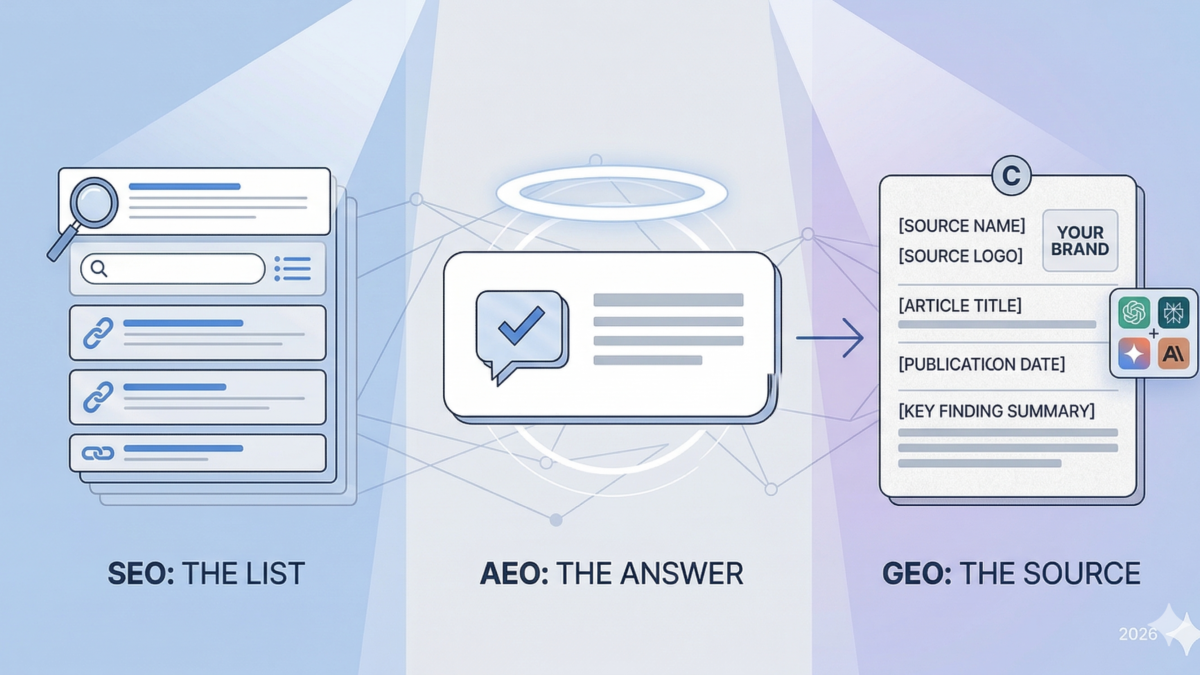
SEO vs AEO vs GEO represents the three pillars of modern search visibility in 2026. SEO optimizes content to rank in search engine results and drive clicks. AEO structures content so AI systems can extract and deliver direct answers without users visiting websites. GEO optimizes content to be cited as a trusted source within AI-generated responses from platforms like ChatGPT, Perplexity, and Google AI Overviews. Together, these three strategies form a unified approach to organic visibility across every surface where people discover information today.
TL;DR: SEO vs AEO vs GEO Summary
- SEO (Search Engine Optimization) targets rankings and clicks through search engine optimization of keywords, backlinks, and technical site health.
- AEO (Answer Engine Optimization) structures content for AI extraction, featured snippets, and direct answers in voice search and AI Overviews.
- GEO (Generative Engine Optimization) optimizes content to be cited as a source within AI-generated responses on platforms like ChatGPT, Perplexity, Gemini, and Claude.
- All three strategies are essential for comprehensive visibility in 2026 — they complement rather than replace each other.
AI systems prioritize content that: directly answers questions in the first 40–60 words, uses question-based headings, includes structured data and schema markup, provides specific statistics with citations, avoids vague qualifiers, and delivers self-contained passages that can stand alone when extracted.
Definition: SEO vs AEO vs GEO
SEO (Search Engine Optimization) improves page rankings in search engines like Google and Bing to increase organic traffic and visibility. SEO relies on keyword optimization, backlink building, technical improvements, and content quality to earn positions on search engine results pages (SERPs). It remains the foundation of digital marketing, with traditional search engines still commanding the vast majority of all discovery traffic in 2026.
AEO (Answer Engine Optimization) structures content so AI-powered systems can extract and cite information as direct answers. AEO targets featured snippets, voice search results, Google AI Overviews, and “Position Zero” placements where users receive answers without clicking through to a website. Organizations reporting positive impact from AEO investments reached 97% in 2025, with 94% planning increased investment according to industry benchmark research from Conductor.
GEO (Generative Engine Optimization) is the practice of optimizing content to be cited as a source within AI-generated responses from platforms like ChatGPT, Perplexity, Google Gemini, and Claude. Unlike SEO which targets ranking positions, and AEO which targets answer extraction, GEO targets citation inclusion, ensuring your brand is referenced when AI platforms synthesize answers for users. Research from Princeton University and IIT Delhi found that specific GEO strategies can boost AI visibility by up to 40%.
Key Distinction: SEO targets clicks through rankings. AEO targets answer extraction by AI platforms. GEO targets citation and brand mention within AI-generated responses. Together, they form a complete organic visibility strategy for 2026.
What Are the Key Differences Between SEO, AEO, and GEO?
The core difference between SEO vs AEO vs GEO lies in what each strategy optimizes for and where the results appear. SEO optimizes for ranking positions to earn clicks from traditional search engine results pages. AEO optimizes content structure so AI systems can extract direct answers and display them in snippets, voice results, or AI Overviews. GEO goes a step further; It optimizes for citation worthiness, ensuring AI platforms like ChatGPT and Perplexity reference your content as a trusted source when generating synthesized answers.
| Dimension | SEO | AEO | GEO |
|---|---|---|---|
| Primary Goal | Rank high on SERPs, drive clicks | Be the extracted direct answer | Be cited in AI-generated responses |
| Target Platforms | Google, Bing, Yahoo | Featured Snippets, Voice Search, AI Overviews | ChatGPT, Perplexity, Gemini, Claude |
| Success Metric | Rankings, organic traffic, CTR | Snippet capture rate, answer visibility | Citation frequency, AI Share of Voice |
| Content Format | Keyword-optimized pages and posts | Q&A structure, concise 40–60 word answers | Authoritative, data-rich, semantically complete |
| Key Tactics | Keywords, backlinks, technical SEO | Schema markup, FAQ structure, direct answers | Statistics, citations, expert quotes, entity clarity |
| User Behavior | User clicks through to website | User reads answer on SERP (zero-click) | User reads AI synthesis (zero-click or citation link) |
Google maintains dominant search market share, and the first listing on page one captures a disproportionately large share of clicks. Most users never navigate past the first results page, making ranking position critical for traditional search visibility. However, according to 2025 AI traffic data, AI-referred sessions jumped 527% year-over-year, signaling a major shift in how people discover information. This means businesses can no longer rely on SEO alone. They need all three pillars working together.
Understanding User Intent Across SEO, AEO, and GEO
User intent drives content creation differently for each approach. SEO content often targets transactional and navigational queries where users want to visit websites. AEO content prioritizes informational queries where users seek immediate answers. GEO content focuses on complex, multi-faceted queries where AI platforms synthesize responses from multiple sources. These are the long-tail, conversational prompts users type into ChatGPT or Perplexity.
Pro Tip: Structure informational content with clear, direct answers in opening sentences. AI systems demonstrate higher extraction rates from content that answers questions immediately rather than building toward conclusions. Lead each section with a definitive statement, then expand with supporting evidence, statistics, and expert context. This AI-extractable content structure serves all three optimization strategies simultaneously.
Why Does GEO Matter in 2026 and How Does It Differ from SEO and AEO?
Generative Engine Optimization matters in 2026 because AI platforms have become a primary discovery channel. ChatGPT alone processes billions of prompts daily, Perplexity handles over 780 million monthly queries, and Google AI Overviews now reaches more than 200 countries in over 40 languages. When users ask these platforms questions, the AI synthesizes answers from multiple sources and cites the most authoritative, relevant content. GEO ensures your content is among those cited sources.
The fundamental difference between GEO and traditional SEO is the end goal. A page can rank number one in Google but never get cited by ChatGPT if it lacks the structural elements AI engines prioritize. According to Search Engine Land’s 2026 GEO guide, when an AI engine names your brand in its answer, it delivers an implicit endorsement that no organic listing alone could provide.
The difference between GEO and AEO is more nuanced. AEO originally emerged to optimize for voice search and featured snippets, structured answers displayed on the search results page. GEO extends this concept to full generative platforms where AI doesn’t just extract a snippet but synthesizes entire responses from multiple sources. In practice, AEO is increasingly considered a subset of the broader GEO discipline, since most voice queries now route through AI systems that use the same generative response mechanisms.
What the Princeton GEO Research Reveals
The most significant academic research on GEO comes from a study conducted by researchers at Princeton University, Georgia Tech, the Allen Institute for AI, and IIT Delhi. The study tested nine distinct optimization methods across 10,000 diverse queries and found that three techniques consistently delivered the strongest results:
- Cite Sources: Including citations from credible sources within your content significantly boosts AI visibility. AI engines prioritize content that demonstrates research rigor.
- Statistics Addition: Content with specific, verifiable data points receives preferential citation. Vague claims are overlooked; specific numbers get cited.
- Quotation Addition: Incorporating expert quotes signals human authority and trustworthiness that AI platforms reward.
These three methods achieved a 30–40% improvement in visibility metrics. Critically, the study also found that keyword stuffing, a legacy SEO tactic, actually decreased AI visibility by 10%, proving that generative engines actively penalize outdated optimization approaches.
What Are Warning Signs That Your Strategy Is Not Aligning with AEO and GEO Trends?
Declining organic traffic despite consistent content updates often indicates misalignment with answer engine and generative engine trends. High bounce rates on informative content suggest users find answers elsewhere, in AI Overviews or generative platforms, before reaching your pages.
The presence of AI Overviews in search results correlates with notably lower click-through rates for traditional rankings. When AI systems answer queries directly, users often skip organic results entirely. Research indicates that approximately 70% of search queries now result in zero clicks, as AI engines provide answers directly within the interface.
Warning: If your analytics show traffic drops specifically for informational queries while transactional queries remain stable, AI answer features are likely capturing your potential visitors. This is the clearest signal that your content needs AEO and GEO optimization in addition to traditional SEO.
Additional warning signs include:
- Reduced time-on-page for previously high-performing informational content
- Decreasing impressions despite stable or improved rankings
- Competitor content appearing in AI-generated answers while yours does not
- Your brand never appears when you search relevant queries in ChatGPT, Perplexity, or Gemini
- Content structured around keywords but lacking specific data, citations, or expert perspectives
Understanding how ranking without clicks affects your strategy is essential. Visibility is shifting from click-based metrics to citation-based authority across AI platforms.
What Are Common Misconceptions About SEO, AEO, and GEO?
The most persistent misconception is that SEO is obsolete because of AEO and GEO. This misrepresents their relationship entirely. Traditional search optimization remains foundational and continues driving the majority of organic traffic. SEO is not dying. The game is expanding. As one industry analysis notes, you cannot have effective GEO or AEO without a technically sound website, because AI crawlers use the same sitemaps, robots.txt files, and internal linking structures that traditional bots have relied on for decades.
Another misconception assumes SEO tactics translate directly to GEO success. They do not. Ranking-focused tactics like backlink acquisition differ substantially from citation-worthiness requirements like structured data implementation, semantic completeness, and factual density. According to Ahrefs research on 75,000 brands, branded web mentions correlate three times more strongly with AI visibility than backlinks — the metric traditional SEO has been built around for two decades.
A third misconception treats GEO and AEO as interchangeable. While they share optimization principles, AEO focuses on being the extracted answer displayed in snippets and voice results, while GEO focuses on being cited as a source within synthesized AI responses. The distinction matters because the content requirements differ: AEO rewards concise, standalone answers, while GEO rewards comprehensive, data-rich authority content.
Don’t: Abandon SEO fundamentals for exclusive AEO or GEO focus.
Do: Build AEO and GEO capabilities on strong SEO foundations — they are layers, not replacements.
What Are Actionable Steps to Optimize for SEO, AEO, and GEO Together?
Building an integrated SEO vs AEO vs GEO strategy requires structural content changes while maintaining ranking fundamentals. The good news is there is significant overlap: by doing SEO well, you lay the groundwork for AEO and GEO. Efforts you make for AEO (structuring content clearly) and GEO (establishing authority) circle back to benefit traditional SEO. Here is a practical implementation framework:
Foundation Layer: SEO Essentials
- Ensure fast load times, mobile responsiveness, clean site architecture, and proper crawlability
- Organize content into logical topic clusters that help both search engines and AI systems understand your expertise depth
- Build quality backlinks and strengthen domain authority through effective keyword analysis and strategic content creation
- Maintain technical SEO hygiene: XML sitemaps, structured URLs, and optimized meta tags
Answer Layer: AEO Optimization
- Add FAQ schema markup to pages addressing common questions
- Structure content with question-based headings that match natural language queries
- Provide standalone answer paragraphs of 40–60 words that require no surrounding context to be understood
- Use declarative statements rather than tentative language — AI systems favor confident, direct answers
- Optimize for AI Overviews and featured snippets by placing definitive answers at the start of each section
Citation Layer: GEO Optimization
- Include specific statistics, data points, and quantified claims. The Princeton study found this improves AI visibility by up to 40%
- Cite credible external sources within your content (academic research, government data, authoritative industry reports)
- Incorporate expert quotes and original research that provide unique perspectives AI platforms cannot find elsewhere
- Ensure entity clarity: clearly identify who you are, what you do, and what topics you cover across your site and third-party platforms
- Verify AI crawlers are not blocked in your robots.txt file. Check that your server or CDN is not rejecting AI bot requests
- Consider creating an
llms.txtfile to help AI systems understand your site structure - Refresh cornerstone content regularly with updated data, new insights, and a clear “Last updated” timestamp. AI engines weigh recency when selecting sources
Enterprises allocate an average of 12% of digital budgets to AEO and related optimization according to 2026 investment research from Conductor. Tools like Buzzin Content Studio can help WordPress publishers implement these optimization layers directly within their content workflow, ensuring posts are structured for maximum visibility across search engines, answer engines, and generative AI platforms.
How Do You Troubleshoot Common AEO and GEO Implementation Issues?
Difficulty measuring AEO and GEO success stems from limited visibility into AI citation sources. Unlike traditional SEO with established ranking trackers, answer engine and generative engine optimization require monitoring multiple AI platforms for content appearances. Measurement remains the biggest gap in most GEO strategies. Marketers who have spent years refining Google Analytics dashboards often have no comparable visibility into AI search performance.
Confusion over metric prioritization often delays effective implementation. Traditional metrics like rankings and traffic remain relevant, but citation frequency, AI Share of Voice, and answer visibility require new tracking approaches and tools such as OmniSEO, Otterly.ai, Rankscale, or Ahrefs Brand Radar.
Pro Tip: Monitor AI platforms directly by searching queries your content targets. Track whether your content appears in AI-generated responses on ChatGPT, Perplexity, and Gemini, and document citation patterns over time. This manual audit process, while not scalable long-term, provides immediate insight into your AI visibility baseline.
Common implementation challenges and solutions:
- Issue: Content not appearing in AI answers despite optimization.
Solution: Verify structured data implementation and ensure direct answers appear in the first 60 words of each section. Check that AI crawlers are not blocked by your robots.txt or CDN configuration. Cloudflare recently changed its defaults to block AI bots automatically. - Issue: Inconsistent citation across AI platforms.
Solution: Different AI systems have varying extraction preferences and citation logic. Test content structure variations and optimize for the platforms your audience uses most. - Issue: Rankings stable but organic traffic declining.
Solution: AI Overviews and generative answers are capturing informational query traffic. Shift strategy to include AEO-optimized snippets and GEO-optimized citation hooks within existing high-ranking content. - Issue: Difficulty attributing conversions to GEO efforts.
Solution: AI platforms drive awareness during the research phase. Users often discover your brand through AI citations, then convert later through organic search or direct visits. Track branded search volume increases alongside AI visibility metrics.
What Expert Strategies Maximize SEO, AEO, and GEO Performance Simultaneously?
Effective strategies integrate all three approaches rather than treating them as separate initiatives. The companies winning in 2026 are not choosing between SEO vs AEO vs GEO. They are building content that ranks, gets featured, gets cited, and gets referenced across every platform their audience uses.
AI tools now support keyword and topic research for most SEO professionals, with 86% incorporating AI into their workflows according to 2026 industry surveys. This integration enables faster identification of question patterns that inform SEO, AEO, and GEO content development simultaneously.
The Hybrid Optimization Framework
A hybrid optimization strategy combines all three techniques to create a more effective solution than any single method could achieve alone. When creating content, consider how it can satisfy a human reader, a search engine, a voice assistant, and an AI chatbot simultaneously:
- Audit existing high-performing SEO content for AEO and GEO optimization opportunities. Your best-ranking pages are prime candidates for answer structuring and citation enrichment
- Prioritize question-based content structures for informational topics, using headings that mirror the actual queries people type into both search engines and AI platforms
- Implement comprehensive schema markup across all content types. FAQ, HowTo, Article, and Organization schema help both traditional search and AI systems parse your content
- Include original data, proprietary research, and unique expert commentary. If you publish something no one else has, AI engines have a reason to cite you over alternatives.
- Monitor AI platform responses for content improvement signals. Search your target queries regularly in ChatGPT, Perplexity, and Gemini to understand what gets cited and why
- Invest in brand mentions and earned media across high-authority platforms. Muck Rack’s analysis found that earned media accounts for 82% of all AI citations
For WordPress publishers, tools like Buzzin Content Studio streamline this process by enabling AI-powered content generation with built-in SEO, AEO and GEO optimization directly within the WordPress editor. Learn how to create blog posts fast in WordPress while maintaining optimization across all three pillars.
When to Prioritize SEO vs AEO vs GEO
- Prioritize SEO when: targeting transactional queries, building domain authority, driving direct website traffic for conversion, and establishing technical site foundations.
- Prioritize AEO when: targeting informational queries, optimizing for voice search, competing for featured snippets, and building visibility in Google AI Overviews.
- Prioritize GEO when: targeting complex research queries, building brand authority in AI responses, competing for citation share against industry leaders, and establishing thought leadership.
- Prioritize all three when: executing a comprehensive visibility strategy, operating in competitive markets, investing in long-term content authority, and starting a blog that gets traffic across every discovery channel.
How Is the SEO vs AEO vs GEO Landscape Expected to Evolve?
The distinction between SEO, AEO, and GEO continues evolving as AI integration deepens across search platforms. Several trends are shaping the trajectory for the remainder of 2026 and beyond:
Topic targeting is overtaking keyword targeting for GEO. Generative engines don’t rely on keywords the way traditional search does. While keywords still matter for SEO, GEO success depends more on thoroughly addressing topics and the questions surrounding them. Content that covers a subject comprehensively, addressing multiple angles, use cases, and follow-up questions, outperforms narrow, keyword-focused pieces in AI citation metrics.
AI search performance tracking is becoming essential. As GEO generates measurable leads and traffic, businesses need dedicated tracking tools to measure visibility and ROI from generative engines. This is analogous to how Google Analytics became essential for SEO. The GEO equivalent is still emerging but rapidly maturing.
Brand visibility is replacing ranking position as the primary discovery metric. Since generative engines don’t operate on a traditional ranking system, the focus shifts to citation frequency, brand mention volume, and AI Share of Voice, how often your brand appears in AI-generated answers compared to competitors for specific intent-based queries.
E-E-A-T (Experience, Expertise, Authoritativeness, Trustworthiness) applies to all three strategies. AI systems increasingly evaluate the same trust signals that Google uses. Content that demonstrates genuine expertise, first-hand experience, and verifiable authority earns visibility across search engines, answer features, and generative platforms simultaneously.
Organizations maintaining strong fundamentals across all three approaches — SEO for search, AEO for answers, GEO for citations — position themselves for sustained visibility regardless of how user search behavior shifts. The companies that invest in this integrated approach now will build compounding advantages as AI becomes an increasingly dominant path to information discovery.
Frequently Asked Questions About SEO vs AEO vs GEO
Is SEO dead because of AEO and GEO?
No. SEO remains the foundation of digital visibility. Traditional search engines still drive the vast majority of organic discovery traffic. AEO and GEO are additional layers that extend your reach into AI-powered answer features and generative platforms. You cannot have effective AEO or GEO without strong SEO fundamentals. AI crawlers rely on the same technical infrastructure (sitemaps, robots.txt, internal linking) that search engine bots use.
What is the difference between AEO and GEO?
AEO (Answer Engine Optimization) focuses on structuring content to be selected as a direct answer in featured snippets, voice search results, and AI Overviews. GEO (Generative Engine Optimization) focuses on making your content worthy of citation within synthesized AI responses on platforms like ChatGPT and Perplexity. AEO targets answer extraction; GEO targets source citation. In practice, AEO is increasingly considered a subset of the broader GEO discipline.
Do I need to choose between SEO, AEO, and GEO?
No. The most effective 2026 strategy integrates all three. They share many foundational principles — quality content, clear structure, technical health — but each adds specific requirements. SEO adds keyword and backlink optimization. AEO adds Q&A structure and schema markup. GEO adds citation signals like statistics, expert quotes, and entity authority. A single well-crafted article can rank on Google (SEO), appear in a featured snippet (AEO), and be cited by ChatGPT (GEO).
How do I measure GEO success?
GEO measurement is still maturing. Key approaches include: manually auditing AI platform responses for your target queries, tracking branded search volume increases (which often indicate AI-driven awareness), using emerging tools like OmniSEO, Otterly.ai, or Ahrefs Brand Radar for AI citation monitoring, and measuring referral traffic from AI platforms in Google Analytics 4.
What content changes improve GEO performance the fastest?
Based on the Princeton University GEO study, three changes deliver the fastest improvements: adding specific statistics with source attribution, incorporating credible citations from authoritative sources, and including relevant expert quotes. These methods achieved 30–40% visibility improvements with minimal content changes. Additionally, ensuring AI crawlers can access your content (checking robots.txt and CDN settings) is a critical technical prerequisite.
The SEO vs AEO vs GEO landscape is evolving rapidly, but the core principle remains constant: create genuinely valuable, well-structured, authoritative content that serves your audience wherever they search. Whether they find you through Google, ask a voice assistant, or prompt ChatGPT, your content should be the answer they discover.
Ready to optimize your WordPress content for SEO, AEO, and GEO simultaneously? Buzzin Content Studio helps publishers create AI-optimized, search-ready content directly within WordPress. So every post is built for maximum visibility across every discovery channel.